






Diesel Oil Change Service for Ram and Jeep in Victorville, CA
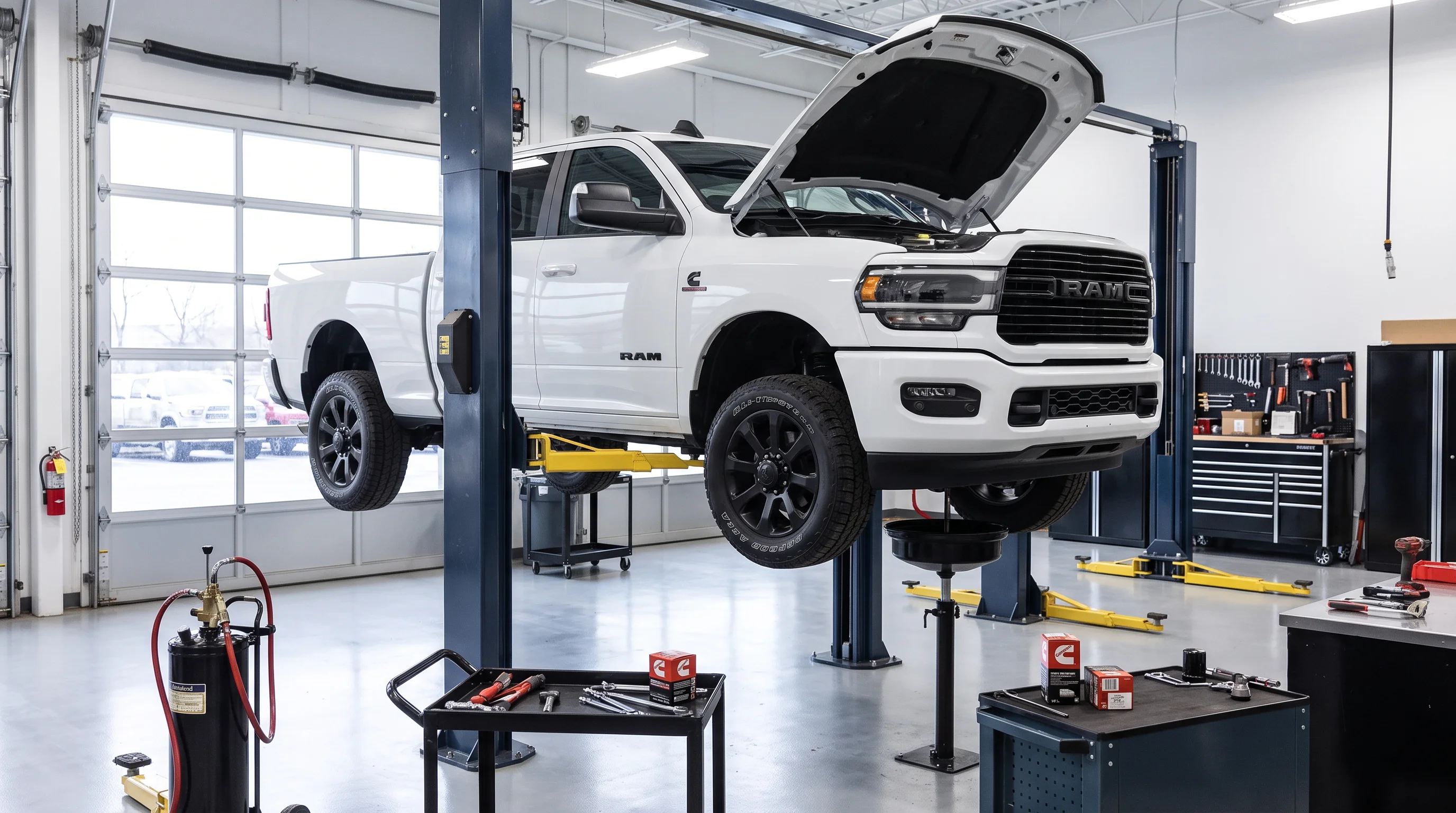
Diesel oil change service at Victorville Motors covers Ram and Jeep diesels with genuine Mopar filters and the exact oil your engine’s factory specification calls for. The work is performed by factory-trained, Mopar-certified technicians.
A diesel is not a gasoline engine running different fuel. It builds far higher combustion pressure, and it pushes much more soot into the oil. That changes what the oil has to do, and it changes how the service is performed.
What a Diesel Oil Change Includes
- Full engine oil drain and refill to your engine’s specified capacity
- New genuine Mopar oil filter, matched to your engine
- Fluid level top-offs
- Multi-point vehicle inspection
- Factory diagnostic tool connection and engine software update check
- Oil life monitor reset
Which Diesel Engines We Service
Two very different diesel engines come through our bays, and their oil requirements are not interchangeable.
The 6.7L Cummins Turbo Diesel powers the Ram 2500 and Ram 3500 Heavy Duty. It remains an available engine on both the 2026 Ram 2500 and the 2026 Ram 3500.
The 3.0L EcoDiesel V6 is no longer in production, but there are plenty still working across the High Desert. It was offered in the Ram 1500 and Jeep Grand Cherokee starting in 2014, and in the Jeep Wrangler and Jeep Gladiator before ending after the 2023 model year. The 2026 Jeep Wrangler is not offered with a diesel engine.
What Oil Type and Capacity Does Your Diesel Need?
The answer depends on your engine and its model year. This is not a detail worth guessing at. Stellantis ties a specific failure mode to the wrong oil in each of these engines, and both warnings are published in service bulletins.
Oil Specification by Engine and Model Year
| Specification | 3.0L EcoDiesel — Gen 2 | 3.0L EcoDiesel — Gen 3 | 6.7L Cummins — 2018 & older | 6.7L Cummins — 2019 & newer |
|---|---|---|---|---|
| Vehicles serviced | Ram 1500 (2014–2019), Jeep Grand Cherokee (2014–2019) | Ram 1500, Jeep Wrangler (2020–2023), Jeep Gladiator (2021–2023) | Ram 2500, Ram 3500, Ram 3500 Cab Chassis, Ram 4500/5500 Cab Chassis | Ram 2500, Ram 3500, Ram 3500 Cab Chassis, Ram 4500/5500 Cab Chassis, including 2026 |
| Capacity with filter | Approximately 10.5 quarts on Ram 1500; approximately 8 quarts on Jeep Grand Cherokee | 9 quarts (8.5 L) on Wrangler and Gladiator; approximately 8.5 quarts on Ram 1500 | 12 quarts (11.4 L) | 12 quarts (11.4 L) |
| Viscosity | 5W-40 full synthetic | 5W-40 full synthetic | 15W-40 above 0°F; 5W-40 below 0°F | 10W-30 above 0°F; 5W-40 below 0°F and year-round. 15W-40 prohibited |
| Material standard | MS-10902 | MS-12991 | MS-10902 | MS-10902 |
| API category | API CJ-4 | API SN or SN+ | API CJ-4 | API CK-4 required; Cummins CES 20081 products also acceptable |
| Oil filter | Replace at every oil change | Replace at every oil change | Replace at every oil change | Replace at every oil change |
Viscosity, material standard and API category sourced from Stellantis service bulletin 09-011-20 (6.7L oil usage) and Stellantis STAR case S2109000010 (EcoDiesel oil specification), published via NHTSA as document MC-10218515. Neither document publishes oil capacities; EcoDiesel capacities are drawn from published EcoDiesel service guidance. Confirm every figure against your own owner’s manual, diesel supplement, and oil fill cap.
Why 15W-40 Cannot Go in a 2019-or-Newer Cummins
Engines built from 2019 onward use hydraulic valve lash adjusters. Stellantis addressed this directly in service bulletin 09-011-20, which states that 15W-40 grade oil cannot be used in any 2019 model year or newer 6.7L equipped vehicle because of the redesigned valve train, and that using it will cause deposits to form in the hydraulic valve lash adjusters, leading to undesirable noise or engine damage.
The replacement grades are specific. The same bulletin sets them out by temperature and model year.
| Operating climate | 2018 model year & older | 2019 model year & newer |
|---|---|---|
| Routinely above 0°F | 15W-40 | 10W-30 — 15W-40 prohibited |
| Routinely below 0°F | 5W-40 synthetic | 5W-40 synthetic |
| Year-round option | 5W-40 synthetic is also safe in summer and warm climates | 5W-40 synthetic is also safe in summer and warm climates |
Per Stellantis service bulletin 09-011-20. Victorville sits well above the 0°F threshold year-round, so 10W-30 is the everyday grade for a 2019-or-newer Cummins here, with 5W-40 available as a year-round alternative.
The Cummins Also Needs a Low-Ash Oil
Beyond viscosity, the oil has to meet the right performance standard. For 2019-and-newer engines the bulletin requires the API CK-4 category and accepts products meeting Cummins Engineering Standard CES 20081. API CK-4 was introduced in December 2016 as the replacement for CJ-4, with improved oxidation resistance, shear stability and aeration control, and it is backward compatible with CJ-4 applications, according to Cummins engine oil specification documentation.
Ash content is the reason the standard matters. Ash does not burn. When the engine consumes a small amount of oil in normal operation, the metallic additives left behind collect in the diesel particulate filter every time the truck runs a regeneration cycle. A high-ash oil shortens the life of an expensive component.
The EcoDiesel Has Two Generations, and Mixing Them Up Damages the Turbo
Stellantis published the split in STAR case S2109000010. Generation 2 covers the 2014–2019 Ram 1500 and Jeep Grand Cherokee, and calls for 5W-40 full synthetic meeting FCA Material Standard MS-10902 with API CJ-4. Generation 3 covers the 2020-and-newer Ram 1500, Jeep Wrangler and Jeep Gladiator, and calls for 5W-40 full synthetic meeting MS-12991 with API SN or SN+.
Both grades read as 5W-40 on the bottle, which is exactly why the mistake happens. The document is explicit about the consequence: using the Generation 2 oil in a Generation 3 engine leads to deposits forming in the turbocharger and reduced performance. We confirm your engine generation by VIN before we open a bottle.
Gasoline Motor Oil Does Not Belong in the Cummins
Passenger-car oils are not tested for the soot dispersancy, shear stability and oxidation resistance that heavy-duty diesel service demands. Those are the properties the diesel categories exist to certify, as the Cummins specification documentation describes.
The Generation 3 EcoDiesel is the one place this needs care rather than a flat rule. Stellantis specifies an oil meeting MS-12991 with API SN or SN+ for that engine, and API SN is a gasoline-engine service category. The approval that matters there is MS-12991, not the API donut, so an ordinary off-the-shelf API SN passenger-car oil is still not a substitute.
The information in this article is general guidance and does not constitute a specific diagnostic or repair recommendation for any individual vehicle. Repair and maintenance decisions should be made in consultation with a certified technician based on the specific condition of your vehicle.
How Often Should Diesel Oil and Filters Be Replaced?
Both engines use an oil change indicator system that monitors how the vehicle is actually driven. That system, not a fixed number on a sticker, is what should govern your service timing.
Read the Diesel Supplement, Not Just the Owner’s Manual
This is where most Cummins owners get tripped up. Ram publishes a separate diesel supplement for Cummins-equipped trucks, and its oil change schedule differs from the general owner’s manual figure that covers the gas engine. Published mileage ceilings for the 6.7L Cummins vary by model year and by which document you are reading, so we are not going to print one number here and call it universal. Bring us your model year and we will confirm the interval that applies to your truck, or check the diesel supplement for your specific vehicle.
Whatever the ceiling turns out to be, it is a maximum and not a target, and the oil change indicator can call for service well before it.
The EcoDiesel Ceiling Is Firmer
For the 3.0L EcoDiesel, the interval should never exceed 10,000 miles or 12 months. Running a biodiesel blend above B5 shortens that to 8,000 miles or six months, per published EcoDiesel service guidance.
Severe Duty Is the Norm in the High Desert
The owner’s manual defines severe duty as operating in dusty conditions, off-road use, or running predominantly at idle. Heavy towing belongs in the same conversation. That describes a lot of working trucks in Victorville, Hesperia, Apple Valley and Adelanto.
Two things catch severe-duty owners out. The first is that dust and soot break oil down faster than highway miles do. The second is engine run time: the maintenance schedule carries an engine-hour limit alongside the mileage limit, and a truck that idles on job sites can reach the hour limit long before the odometer suggests service is due. Fleet and commercial owners hit it routinely. Ask our service advisors what interval fits how you actually use the vehicle.
The Filter Is Not Optional
Every diesel oil change includes a new oil filter, without exception. Reusing a filter puts trapped soot and contaminants straight back into fresh oil and undoes the service you just paid for.
Diesel fuel filters and the fuel/water separator are on their own schedule, and that schedule differs between the Cummins and the EcoDiesel. Higher biodiesel blends shorten it on both. Clean fuel filters protect high-pressure common-rail injectors and the fuel pump, which are among the most expensive components on a diesel. We will tell you where your truck stands when it is on the lift.
The information in this article is general guidance and does not constitute a specific diagnostic or repair recommendation for any individual vehicle. Repair and maintenance decisions should be made in consultation with a certified technician based on the specific condition of your vehicle.
Why Does a Diesel Oil Change Cost More Than a Gas Oil Change?
Three things drive the difference, and none of them is markup.
| Cost driver | Diesel | Typical gasoline engine |
|---|---|---|
| Oil volume | 12 quarts on the 6.7L Cummins; 8 to 10.5 quarts on the 3.0L EcoDiesel | Considerably less, which is why the fill cost alone is lower |
| Oil chemistry | Heavier detergent and dispersant packages to hold soot in suspension, plus a low-ash requirement that narrows the field of qualifying products | Standard additive packages with no low-ash constraint |
| Oil filter | Larger and application-specific; the Cummins in particular has filters that must not be cross-fitted between applications | Smaller, widely cross-compatible spin-on filters |
Genuine Mopar filters are matched to your engine. Before you book, it is worth checking our current Mopar service coupons, because diesel service is where they tend to be worth the most.
How to Schedule Your Ram or Jeep Diesel Oil Change
You can book online any time, or call our service team directly at (760) 493-7902. Scheduling an appointment lets us stage the right oil for your engine before you arrive, in the correct grade, the correct specification and the correct volume, with the matching Mopar filter.
Our Express Lane handles quick routine maintenance without an appointment. For diesel service we generally recommend booking ahead, simply because the correct oil for your specific engine and generation needs to be on hand.
When you schedule, tell us your model year and engine. You can also add related items to the same visit, including tire rotation, fuel filter replacement or a multi-point inspection.
Common Questions About Ram and Jeep Diesel Maintenance
Can I use regular gasoline motor oil in my 6.7L Cummins?
No. Gasoline motor oils are not tested for the soot dispersancy, shear stability and heavy-duty wear protection a high-compression diesel requires. Using one can cause rapid oil breakdown, sludge and elevated engine wear. It also risks the emissions hardware, because oil that does not meet the low-ash standard leaves ash behind in the diesel particulate filter every regeneration cycle.
What happens if the oil is overfilled in a 3.0L EcoDiesel?
In a properly filled engine, the crankshaft spins just above the surface of the oil. Overfill it and the crankshaft begins whipping the oil into foam. Aerated oil cannot lubricate properly and cannot carry heat away, so oil pressure drops and air enters passages that need solid oil. This is why the correct capacity matters, and why the level is confirmed on the dipstick rather than by counting bottles.
Why does the EcoDiesel take a different amount of oil in a Jeep than in a Ram?
Oil pan depth. The Generation 3 engine was packaged to fit vehicles with a solid front axle, which needs articulation clearance, so the Wrangler and Gladiator take 9 quarts while the Ram 1500 application takes approximately 8.5. It is a real difference, not a rounding error, and it is one more reason the fill is confirmed on the dipstick.
Why does diesel engine oil turn black almost immediately?
Carbon soot. High-compression diesel combustion produces it continuously, and the oil’s dispersant additives are designed to hold it in suspension so it cannot form sludge. Dark oil is normal in a diesel within the first miles after a change. Color is not a useful indicator of oil condition in either direction, so let the interval and the oil change indicator drive your service timing rather than how the oil looks on the dipstick.
What oil should I run in a heavy-duty Ram diesel in cold weather?
For any model year 6.7L Cummins, 5W-40 synthetic is the grade specified for climates that routinely fall below 0°F, and the same bulletin notes it is also safe to use in summer and in warmer climates. Above 0°F, a 2019-or-newer engine takes 10W-30 and a 2018-or-older engine takes 15W-40. The one rule that does not bend: 15W-40 is prohibited on 2019-and-newer engines regardless of climate.
Is API CK-4 still the current diesel oil category?
Yes, as of August 2026. API formally approved the next-generation PC-12 specification in April 2026, which introduces API CL-4 as the successor to CK-4, but the first licensing date for those new categories is January 1, 2027. Until then, CK-4 is what your Cummins calls for and what you will find on the shelf.
The information in this article is general guidance and does not constitute a specific diagnostic or repair recommendation for any individual vehicle. Repair and maintenance decisions should be made in consultation with a certified technician based on the specific condition of your vehicle.
Keep Your Diesel Ram or Jeep Running Strong
The right oil, the right specification and the right interval are the least expensive protection available for a turbocharger, a set of injectors and a diesel particulate filter. On these engines the specification is not a preference. It is tied to failure modes the manufacturer has documented, and it changes by model year and engine generation.
Our team services Cummins and EcoDiesel vehicles for drivers across Victorville, Hesperia, Apple Valley and Adelanto. Bring us the year and engine, and we will handle the rest. For more maintenance guidance, explore our service tips and resources.
Disclaimers
The information in this article is general guidance and does not constitute a specific diagnostic or repair recommendation for any individual vehicle. Repair and maintenance decisions should be made in consultation with a certified technician based on the specific condition of your vehicle.
0 comment(s) so far on Diesel Oil Change Service for Ram and Jeep in Victorville, CA