






RAM Tire Pressure Guide
Why Proper Tire Pressure Matters for Your RAM in the High Desert
Keeping your RAM’s tire pressure at the right level is one of the simplest — and most overlooked — steps in protecting your truck’s safety, performance, and longevity. For drivers in Victorville, Hesperia, Apple Valley, and Adelanto, the High Desert puts real pressure on your tires. Temperature swings, long I-15 highway runs, and the daily demands of work and weekend hauling all add up fast.
Our climate adds another wrinkle: tire pressure drops roughly 1 PSI for every 10°F decrease in temperature. A truck parked overnight at 50°F that warms to 90°F by midday can swing 3–4 PSI on its own. That’s why a once-a-month pressure check — paired with seasonal adjustments — belongs in every RAM owner’s routine.
What’s the Right Tire Pressure for My RAM?
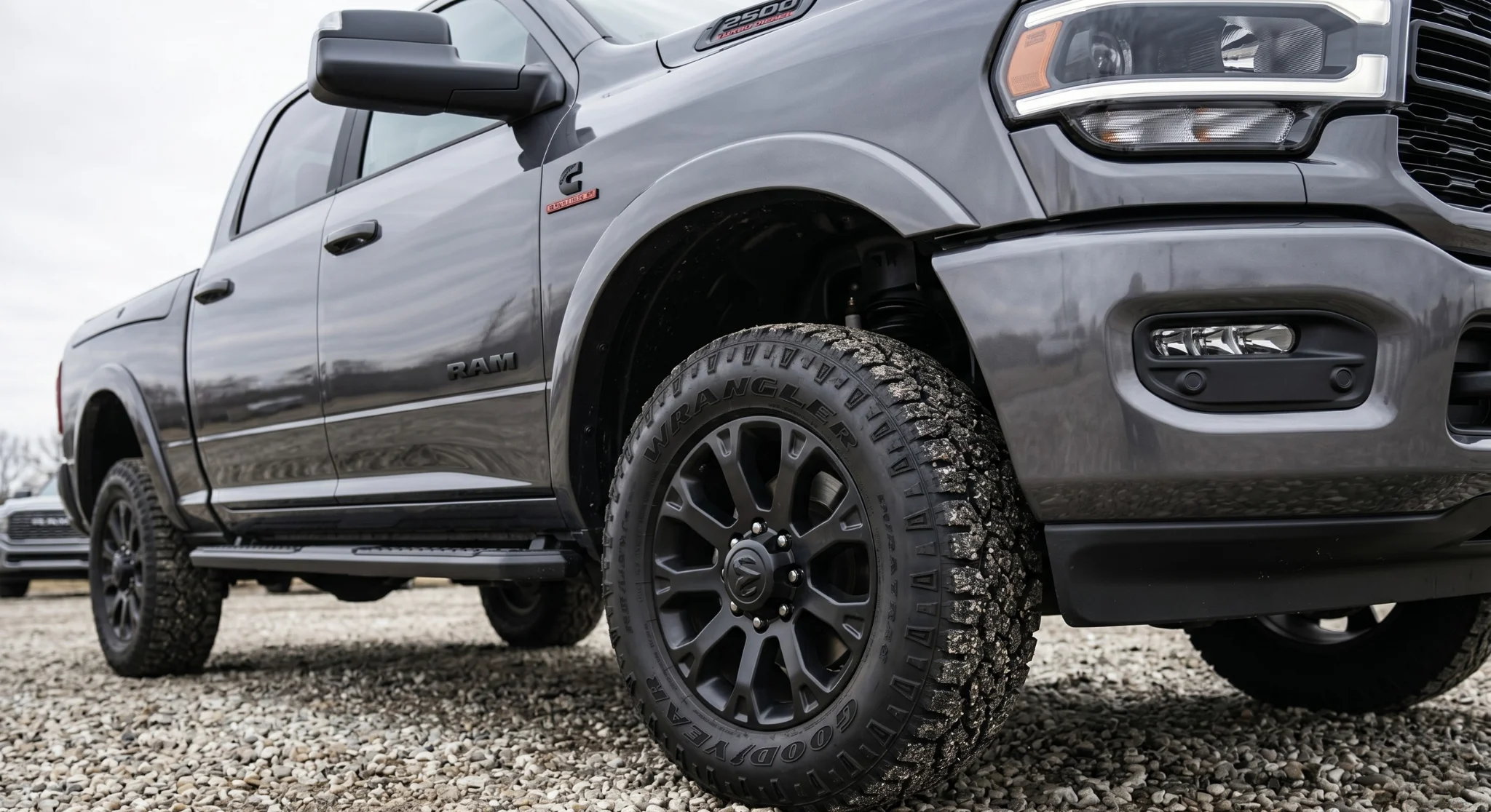
Here’s the honest answer: it depends. RAM tire pressure varies by model, trim, tire size, and load. The right answer is always the value printed on the tire and loading information placard located on the driver’s-side door jamb — or in your owner’s manual. Below is general guidance for the most common RAM models. Use it as orientation only — your placard is the authority.
| RAM Model | Typical Door Jamb Range |
|---|---|
| RAM 1500 (Light-Duty) | 32–55 PSI — many factory street setups sit around 36 PSI cold; off-road and heavy-duty packages run higher. See our 2026 RAM 1500 Overview for the latest model-year details. |
| RAM 2500 & 3500 (Heavy-Duty) | 60–75 PSI front / 60–80 PSI rear — built for serious payload. Pressures feel firm when empty but stay at the placard value for safety. |
| RAM ProMaster (Commercial) | Approximately 39–80 PSI — varies widely by cargo van class and intended load. |
Your Door Jamb Is the Truth
The pressure on your door jamb is set by RAM engineers based on your specific truck’s weight, suspension, and rated load capacity. It beats the maximum number molded into the tire sidewall, and it beats anything you’ll find in a forum thread. Aftermarket tires or wheel changes can alter what’s appropriate — when in doubt, our certified service team can confirm the right setup for your configuration.
Common Problems Caused by Incorrect Tire Pressure
Pressure outside the recommended range causes problems that cascade quickly — either way, your tire investment shrinks.
| Issue | What It Causes |
|---|---|
| Underinflation | Extra friction with the road, faster wear along the outer edges, lower fuel efficiency, and heat buildup — the leading cause of blowouts on long, hot desert drives. |
| Overinflation | Reduced traction, a harsher ride, wear concentrated in the center of the tread, and longer braking distances — the truck can feel twitchy on uneven pavement. |
Understanding Your RAM’s Tire Pressure Technology
Every modern RAM truck includes built-in tools to help you maintain correct pressure. Here’s what they are and what they do.
| System | What It Does |
|---|---|
| Tire Pressure Monitoring System (TPMS) | Direct in-wheel sensors measure actual pressure in each tire. The dashboard warning light triggers when pressure drops about 25% below the placard value. Required by federal law on all new vehicles since 2008. |
| Tire Fill Alert (TFA) | This Mopar feature uses your hazard lights and horn to signal when each tire reaches placard pressure during inflation — no separate gauge needed for the basic check. |
| Selectable TFA (STFA) | Available on some 2500 and 3500 models — lets you set custom target pressures through Uconnect for aftermarket tire setups. |
| Trailer TPMS (TTPMS) | Available factory option for owners who tow. Monitors trailer tire pressure directly through Uconnect — no aftermarket dashboard required. |
TPMS — A Few Things to Know
If the warning light stays on after you’ve correctly inflated all tires, the most common causes are a slow leak, a damaged valve stem, or a TPMS sensor with a depleted battery (sensors typically last 5–10 years). Most configurations clear the warning automatically after a few minutes of driving, though some require a manual reset through the Uconnect or instrument cluster menu. Our service team can diagnose all three causes.
TFA — How to Activate It
With the truck in PARK and ignition in RUN, TFA activates when it detects pressure changes greater than 1.5 PSI. The hazard lights flash to confirm it’s monitoring, and the horn signals when target pressure is reached. Enable TFA through your radio’s settings menu. If it isn’t behaving as expected, our service team can troubleshoot.
TTPMS — For Owners Who Tow
The factory TTPMS requires the trailer tow package and Mopar trailer TPMS sensors. The system supports 1–3 axles, 2 to 12 trailer tires, pressures from 25–125 PSI, and multiple paired profiles for owners with more than one trailer. Pairing happens through Uconnect’s trailer settings menu — our service department handles activation and pairing routinely.
A Simple 4-Step Tire Pressure Routine
Maintaining proper pressure doesn’t have to be complicated. Build this into your monthly truck care.
| Step | Action | Why It Matters |
|---|---|---|
| 1. Check Cold | Measure before driving, or after the truck has sat for at least 3 hours. | Driving heats tires and adds 3–5 PSI to readings, throwing off accuracy. |
| 2. Adjust for Load | Hauling or towing? Use the max-load placard value (typically 3–5 PSI above the standard setting). | Prevents tire flex and heat buildup under heavy weight. |
| 3. Track Temperature | Re-check seasonally and after large day-to-night temperature swings. | Pressure drops about 1 PSI for every 10°F decrease. |
| 4. Look + Measure | Inspect each tire for sidewall cracks, bulges, foreign objects, and uneven tread wear. | Catches problems a gauge can’t see — the difference between a service appointment and a roadside emergency. |
When to Bring Your RAM to Victorville Motors
Some tire pressure issues are quick DIY fixes. Others need a professional eye. Bring your truck in if you notice any of these:
| Symptom | What It Likely Means |
|---|---|
| TPMS light won’t reset after correct inflation | Sensor fault, slow leak, or recalibration needed |
| Pressure dropping more than 2 PSI per week | Slow leak — likely a puncture, valve stem, or bead seal issue |
| Uneven tread wear (center, edges, or one side) | Persistent inflation issue or alignment problem |
| Sidewall damage, cracks, or bulges | Structural tire failure risk — replace promptly |
| Pressure differences between tires on the same axle | Sensor or seal issue |
| Need to pair a trailer for TTPMS | Activation or setup required |
| Aftermarket tire installation | TPMS may require reprogramming for the new tire spec |
Our technicians know the RAM platform — from the 1500 you commute in to the 3500 dually you tow with, and the ProMaster you depend on for work. We have the diagnostic tools to handle TPMS sensor relearns, valve stem service, and tire replacement done right. For Mopar replacement TPMS sensors and tire-related parts, visit our Parts Department or call (760) 513-6605. We’re also a registered California Bureau of Automotive Repair shop — so you get factory-trained service backed by California’s strictest standards.
Free Tire Pressure Checks at Victorville Motors
Tire pressure is one of those small things that makes a big difference. We offer complimentary tire pressure checks at our service department — no appointment required for the basics. Whether you drive a 1500, a heavy-duty 2500 or 3500, or a ProMaster work van, your RAM deserves proper care. Stop in, ask questions, and let our certified technicians keep your truck running its best across every mile of the High Desert — Victorville, Hesperia, Apple Valley, Adelanto, Phelan, and beyond.
Visit us at 14617 Civic Dr, Victorville, CA 92394.
Fuel efficiency benefits described in this guide are general and depend on driving conditions, vehicle configuration, tire condition, and other factors.