






Heavy-Duty Towing Power for High Desert Contractors
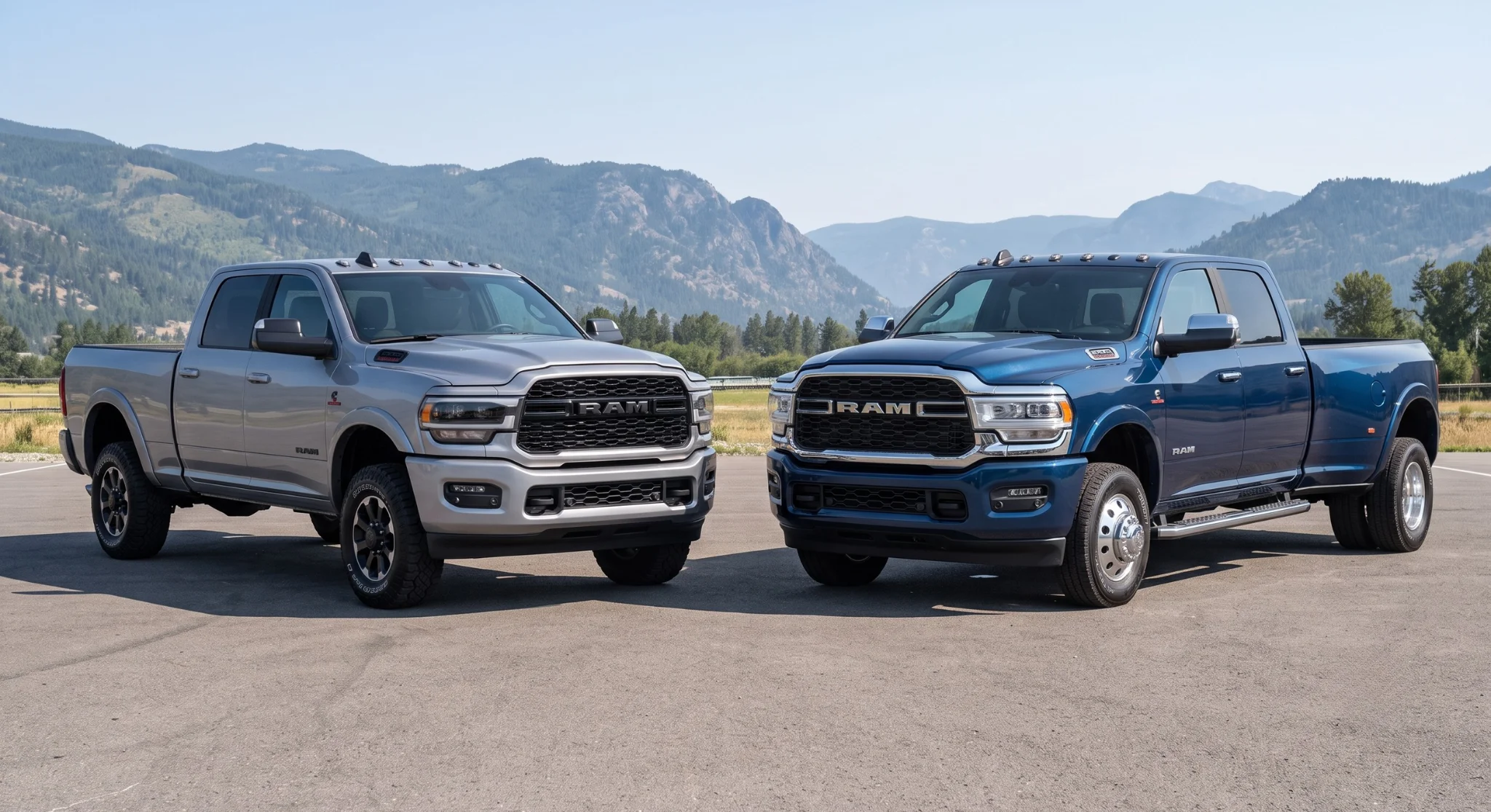
Demanding commercial work in the High Desert calls for trucks that hold up when the temperature climbs and the payload gets heavier. Local construction crews, agricultural operations, and independent contractors know that hauling equipment up steep desert grades is no job for a light-duty truck. At Victorville Motors on Civic Drive, we stock a robust selection of Ram Heavy Duty trucks built for exactly these conditions.
Whether you’re pulling heavy machinery, moving livestock, or hauling bulk materials, our team can help you match the right truck to the work. Reach out or browse the current Ram HD lineup to get started.
The 2026 Ram HD Diesel Lineup: One Cummins, More Capability
For 2026, the Ram Heavy Duty lineup carries a single, more powerful Cummins® across the entire range. For years, the Ram 2500 came with a standard-output Cummins while the high-output engine was reserved for the 3500. That split is gone: the standard-output diesel has been retired, and Ram now fits one Cummins to every Heavy Duty diesel truck.
What that means for a contractor shopping in 2026:
- The High-Output 6.7L Cummins Turbo Diesel — 430 hp and 1,075 lb-ft of torque — is the diesel in both the Ram 2500 and Ram 3500.
- It pairs with the TorqueFlite® HD eight-speed automatic (built by ZF), which replaced the older six-speed units for a wider gear spread, better grade performance, and lower cruising RPM.
- You no longer have to step up to a 3500 just to get the 1,075 lb-ft engine — the 2500 can be ordered with it straight from the factory.
Ram 2500 Towing and Payload With the 6.4L HEMI V8
The standard engine across the Heavy Duty lineup is the 6.4L HEMI® V8, producing 405 hp and 429 lb-ft of torque and paired with the TorqueFlite 8 eight-speed automatic. It’s the choice for contractors who prioritize lower up-front cost, gasoline simplicity, and strong payload for carrying tools, service bodies, and materials in the bed.
Maximum Capability, Properly Equipped
| Specification | Ram 2500 with 6.4L HEMI V8 |
|---|---|
| Horsepower | 405 hp |
| Torque | 429 lb-ft |
| Maximum towing | Up to 17,750 lb |
| Maximum payload | Up to 3,930 lb (certain Regular Cab builds reach higher) |
| Transmission | TorqueFlite 8 eight-speed automatic |
Because the gas V8 weighs less than the diesel, HEMI configurations generally deliver the highest payload ratings in the lineup — the better pick when your daily load rides in the truck rather than behind it.
Maximum towing and payload capacity figures are based on properly equipped vehicles and vary by configuration. Do not exceed any weight rating. See your owner’s manual and the vehicle’s door-jamb label for specific capacities.
If you’re maximizing budget or need a capable second work truck, our used inventory is a good place to find a gas-powered heavy-duty Ram ready to work.
The 2026 Cummins Story: High Output, Now Standard
When maximum pulling power is non-negotiable, the Cummins inline-six turbo diesel is the benchmark — and for 2026 there’s just one version to know.
High-Output 6.7L Cummins Turbo Diesel
| Specification | High-Output 6.7L Cummins Turbo Diesel |
|---|---|
| Horsepower | 430 hp |
| Torque | 1,075 lb-ft (best-in-class available base diesel torque) |
| Transmission | TorqueFlite HD eight-speed automatic (ZF-built), standard on all diesel HD trucks |
| Availability | Available on both Ram 2500 & Ram 3500 |
| Max towing — Ram 2500 | Up to 20,000 lb |
| Max towing — Ram 3500 | Up to 36,610 lb (DRW gooseneck configuration) |
If your business pulls large gooseneck trailers or heavy machinery, the diesel is the powertrain that does it — and for 2026 you can get it in either truck.
2026 Ram Heavy Duty Engine Lineup
| Engine | Horsepower | Torque | Transmission | Availability |
|---|---|---|---|---|
| 6.4L HEMI V8 (gas) | 405 hp | 429 lb-ft | TorqueFlite 8 (8-speed) | Standard on Ram 2500 & 3500 |
| High-Output 6.7L Cummins Turbo Diesel | 430 hp | 1,075 lb-ft | TorqueFlite HD (8-speed) | Available on Ram 2500 & 3500 |
Maximum towing and payload capacity figures are based on properly equipped vehicles and vary by configuration. Do not exceed any weight rating. See your owner’s manual and the vehicle’s door-jamb label for specific capacities.
Investing in a heavy-duty diesel is a major business decision, and our finance team can help you pursue competitive rates. You can start by prequalifying online.
Ram 2500 vs. Ram 3500 — Which One Fits Your Work
Most contractors land on one question: do I need the 3500? The honest answer depends on whether you’re chasing maximum towing or maximum payload, and whether your loads justify dual rear wheels.
- Choose the Ram 2500 if you tow in the 12,000–20,000 lb range and want a truck that’s easier to live with day to day. Its class-exclusive coil-link rear suspension rides better unladen.
- Choose the Ram 3500 if you’re regularly loading heavy goosenecks, running near the top of the rating, or need the highest payload — especially in dual-rear-wheel (DRW) form.
| Capability (properly equipped) | Ram 2500 | Ram 3500 |
|---|---|---|
| Max towing — HEMI V8 | Up to 17,750 lb | Up to 18,150 lb |
| Max towing — HO Cummins Diesel | Up to 20,000 lb | Up to 36,610 lb (DRW gooseneck) |
| Max payload — HEMI V8 | Up to 3,930 lb | Up to 7,590 lb |
Maximum towing and payload capacity figures are based on properly equipped vehicles and vary by configuration. Do not exceed any weight rating. See your owner’s manual and the vehicle’s door-jamb label for specific capacities.
Explore each truck in detail on our Ram 2500 and Ram 3500 pages.
Do You Need a CDL to Tow at Maximum Capacity in California?
Licensing is one of the most common questions contractors ask before hitching up — and in California the answer depends on trailer weight ratings and whether you’re towing for compensation, not just on the truck itself. Here’s the general framework; confirm your specific situation with the California DMV’s recreational trailer endorsement guidelines.
| Trailer setup | Generally required |
|---|---|
| Trailer or fifth-wheel under 10,000 lb GVWR (not for hire) | Standard Class C |
| Fifth-wheel travel trailer 10,001–15,000 lb GVWR (not for hire) | Class C with Restriction 41 endorsement |
| Bumper-pull trailer over 10,000 lb GVWR, or fifth-wheel over 15,000 lb GVWR (not for hire) | Non-Commercial Class A |
| Towing for compensation with GCWR 26,001+ lb and trailer over 10,000 lb GVWR | Commercial Class A (CDL) |
Two takeaways for contractors:
- A CDL isn’t automatically required just because you own a heavy-duty truck. Commercial (CDL) rules generally apply when you’re towing for compensation at higher combined weights.
- Non-commercial hauling of a heavy trailer can still require a Non-Commercial Class A license based on the trailer’s GVWR — a step many owners overlook.
Because the specifics turn on your exact truck-and-trailer weight ratings and how you use them, check the weight plates on both units and verify with the California DMV before you tow.
Not sure how your setup lines up? Our Ram truck specialists can walk you through the capability packages and weight ratings on the trucks we stock.
Trailer Reverse Steering Control on the Job Site
Backing a heavy trailer into a tight, cluttered site is one of the most stressful parts of a contractor’s day. Ram’s available Trailer Reverse Steering Control simplifies it.
How It Works
- A dedicated knob on the center stack lets you point the trailer where you want it to go.
- You watch the camera feed on the Uconnect touchscreen while rotating the knob.
- The truck’s computer takes over the steering wheel and executes the counter-steering for you.
The result: no mentally reversing your inputs, which is exactly what makes backing fifth-wheels and goosenecks around active work zones easier — and reduces the risk of jackknifing. It’s an available feature, offered with Ram’s trailering technology, alongside trailer tire-pressure monitoring and surround-view camera options.
Ram 3500 Chassis Cab and Upfit-Ready Platforms
For specialized work platforms, the choice between a standard pickup box and a Chassis Cab is fundamental. A regular Ram 3500 pickup ships with a traditional cargo bed; the Ram 3500 Chassis Cab ships with an exposed rear frame built to accept aftermarket bodies — dump beds, service bodies, crane rigs, or custom flatbeds.
Key Platform Differences
- Frame design: the pickup uses a curved rear frame tuned for ride comfort; the Chassis Cab uses flat, straight rails with industry-standard spacing for simpler, more secure upfits.
- Rear suspension: pickups balance towing and daily ride quality; Chassis Cabs run heavy-duty leaf-spring setups for constant high-capacity loads.
- Upfitter-friendly for 2026: PTO (Power Take-Off) prep is now standard on diesel and gas Chassis Cabs with the new transmission, with easier integration for third-party equipment.
If you’re ready to build out a custom commercial rig, reach out to our commercial sales team to view chassis inventory and discuss upfit compatibility.
Contractor Questions About Ram Heavy-Duty Towing
Can I tow a gooseneck trailer with the standard 6.4L HEMI V8 engine?
Yes. While the diesel is preferred for the heaviest long-distance hauling, the HEMI V8’s towing capacity — up to 17,750 lb in the Ram 2500 when properly equipped — is more than enough for the smaller goosenecks, flatbeds, and dump trailers common on local job sites.
How does the ride quality compare when towing versus driving empty?
Heavy-duty trucks are built to carry heavy loads, so the rear suspension can feel stiff with an empty bed. Once you hook up a trailer or load the bed, the rear springs compress and the ride settles into something more planted and controlled.
Do I need a special break-in procedure before towing a new Ram truck?
Ram’s owner’s manual recommends easing into the first several hundred miles — generally avoiding heavy towing early — to let the engine, transmission, and axle gears seat properly. Follow the break-in guidance in your specific truck’s owner’s manual for the details that apply to your powertrain.
What is the benefit of the active noise cancellation system when towing?
Towing works the engine harder at higher RPM, which raises cabin noise. Ram HD’s acoustic glass and active noise cancellation work together to keep the cabin quieter, helping reduce driver fatigue on long days.
How do I know if my truck has the correct axle ratio for maximum towing?
Axle ratio directly affects towing capacity. You can confirm your truck’s exact axle ratio and towing limit by checking the door-jamb sticker, referencing the VIN, or asking one of our Ram truck specialists.
Is the 2026 Ram powertrain warranty really 10 years?
For 2026, Ram offers a 10-year/100,000-mile limited powertrain warranty — but it applies to the original owner only and excludes fleet purchases. For subsequent owners, coverage reverts to 5-year/60,000-mile (gas) or 5-year/100,000-mile (diesel). Confirm eligibility for your specific purchase.
Warranty terms and covered components per the official Ram powertrain warranty details.
This information is provided for general educational purposes only and does not constitute legal advice. Warranty coverage depends on the specific terms of your vehicle’s warranty agreement. Consult your owner’s manual or a qualified legal professional for guidance on your individual situation.
Disclaimers
This information is provided for general educational purposes only and does not constitute legal advice. Warranty coverage and towing/licensing requirements depend on the specific terms of your vehicle’s warranty agreement and applicable regulations. Consult your owner’s manual, the California DMV, or a qualified professional for guidance on your individual situation.