







2027 Jeep Grand Cherokee L vs. 2027 Jeep Grand Wagoneer: Midsize or Full-Size?
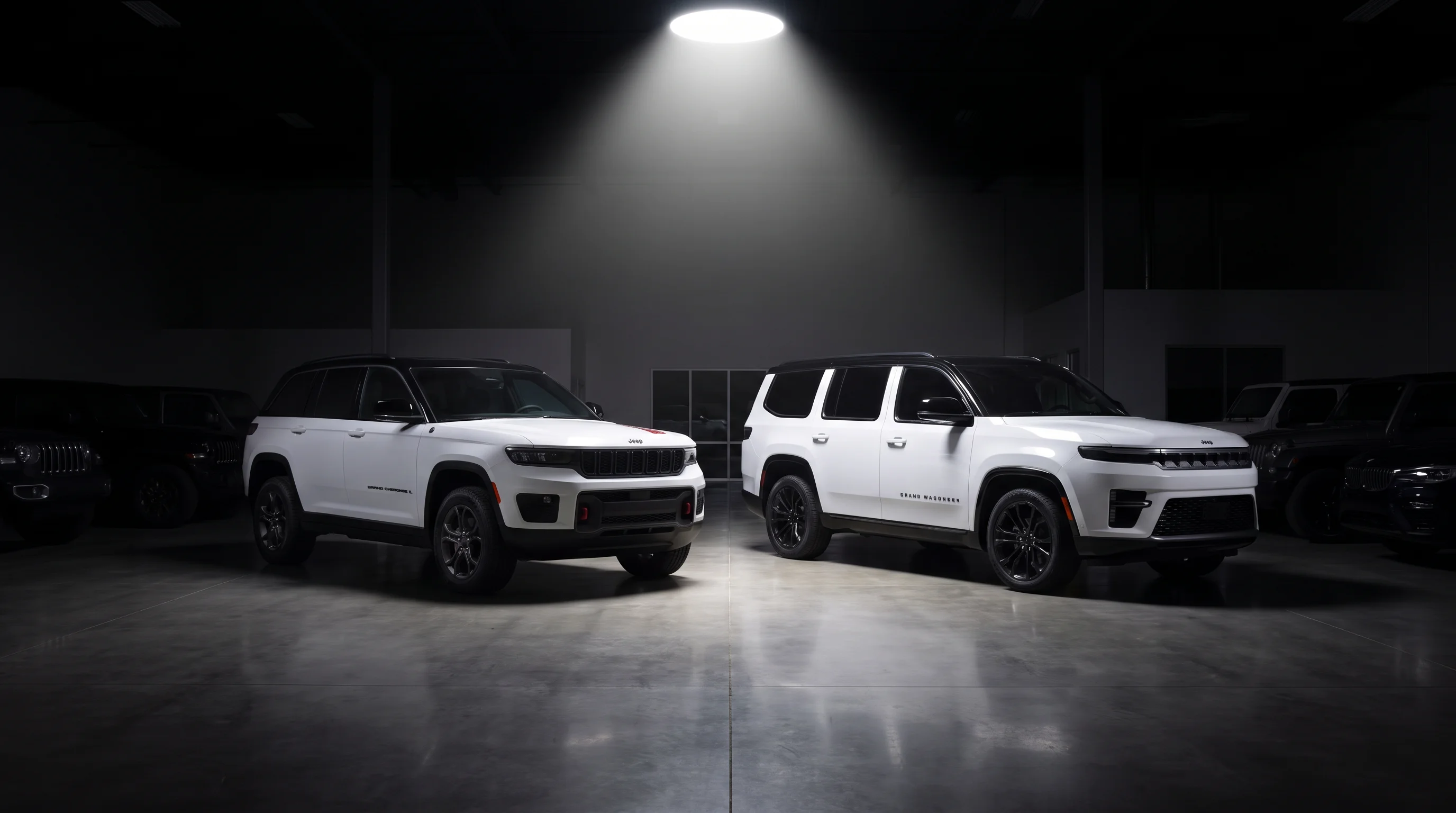
Both the 2027 Jeep Grand Cherokee L and the 2027 Jeep Grand Wagoneer carry three rows and can seat seven. The choice between them is not about headcount. It is about size class and capability. The Grand Cherokee L is a midsize three-row starting at $43,515 MSRP that tows up to 6,200 pounds. The Grand Wagoneer is a full-size, body-on-frame SUV starting at $67,595 MSRP that tows up to 10,000 pounds and holds 27.9 cubic feet behind its third row against the Grand Cherokee L’s 17.2.
Manufacturer’s Suggested Retail Price (MSRP) for new vehicles includes manufacturer and distributor options and delivery, process and handling fees, which may be subject to change at any time. MSRP excludes taxes, title, license and dealer installed options, accessories, fees and charges. MSRP is not the dealer advertised price. Dealer price will vary. The dealer sets the final price.
Maximum towing and payload capacity figures are based on properly equipped vehicles and vary by configuration. Do not exceed any weight rating. See your owner’s manual and the vehicle’s door-jamb label for specific capacities.
Which Three-Row Jeep Fits Your Family?
For High Desert households, the decision comes down to what you tow and where you park. Both Jeeps seat seven. Both carry three rows. From there they diverge sharply.
The Grand Cherokee L is the midsize answer. It fits a standard garage, returns better fuel economy, and starts about $24,000 lower in MSRP. For families whose heaviest weekend load is gear and passengers, that gap buys a lot of trim and equipment. If a midsize three-row is where you are landing, our 2026 Jeep Grand Cherokee L vs. Dodge Durango comparison covers the other side of that shopping list.
The Grand Wagoneer is the full-size answer. It tows about 61% more, holds meaningfully more cargo behind the third row, and rides on a body-on-frame platform built for sustained load. For a household pulling a travel trailer or a boat toward Big Bear on a regular basis, that difference is not a nice-to-have — it is the whole decision. Shoppers weighing the full-size range can also see our Jeep Wagoneer vs. Grand Wagoneer comparison.
Pricing and Trim Ranges
The Grand Cherokee L spans six trims; the Grand Wagoneer spans four in standard-wheelbase form. Both ladders climb well past their starting figures.
| Specification | 2027 Jeep Grand Cherokee L | 2027 Jeep Grand Wagoneer |
|---|---|---|
| Starting price | $43,515 MSRP | $67,595 MSRP |
| Range-topping price | $64,895 MSRP (Summit) | $103,910 MSRP (Summit Reserve) |
| Trims | Laredo, Laredo X, Laredo Altitude, Limited, Limited Reserve, Summit | Grand Wagoneer, Limited, Summit, Summit Reserve |
| Segment | Midsize three-row SUV | Full-size luxury SUV |
Manufacturer’s Suggested Retail Price (MSRP) for new vehicles includes manufacturer and distributor options and delivery, process and handling fees, which may be subject to change at any time. MSRP excludes taxes, title, license and dealer installed options, accessories, fees and charges. MSRP is not the dealer advertised price. Dealer price will vary. The dealer sets the final price.
Worth noting for anyone budgeting off the starting figures alone: a well-equipped Grand Cherokee L Summit lands within a few thousand dollars of an entry Grand Wagoneer. Shoppers who assume the two lineups never overlap are often surprised at where they actually meet.
Seating and Cargo Space
Seating tops out at seven in both. Cargo is where they part ways.
Grand Cherokee L: Midsize Flexibility
Jeep lists the Grand Cherokee L with available seating for up to seven passengers and 17.2 cubic feet of cargo room with all seats up. Second-row captain’s chairs seat six and make third-row access easier; the available second-row bench brings capacity to seven. Front-row passengers get 41.3 inches of legroom and 39.8 inches of headroom. Fold the third row and cargo room grows to 46.9 cubic feet. Fold both rear rows and it reaches 84.6 cubic feet.
Grand Wagoneer: Full-Size Capacity
The Grand Wagoneer holds 27.9 cubic feet behind its third row — more than 10 cubic feet of additional everyday space — and 70.8 cubic feet with the third row folded. Seven-passenger seating is standard, and an eight-passenger configuration is available on every trim except Summit Reserve. The trade-off is footprint: the Grand Wagoneer is a genuinely large vehicle to park and maneuver.
| Specification | 2027 Jeep Grand Cherokee L | 2027 Jeep Grand Wagoneer |
|---|---|---|
| Seating | 6 with second-row captain’s chairs; up to 7 with the available second-row bench | 7 standard; 8 available (except Summit Reserve) |
| Cargo behind third row | 17.2 cu ft | 27.9 cu ft |
| Cargo, third row folded | 46.9 cu ft | 70.8 cu ft |
Performance, Towing, and Fuel Economy
This is where the two separate most.
Grand Cherokee L Engines
Two engines are offered. Laredo and Laredo X trims use the 3.6L Pentastar V6, which Jeep rates at 293 maximum horsepower and 260 lb-ft of torque. Laredo Altitude and every trim above it use the 2.0L Hurricane 4 Turbo at 324 horsepower and 332 lb-ft. Both engines reach the same maximum towing capacity of 6,200 pounds when properly equipped, which Jeep calls best-in-class. Rear-wheel drive is standard, with four-wheel-drive systems available.
Grand Wagoneer Engine
Every 2027 Grand Wagoneer runs the 3.0L Hurricane twin-turbo inline-six, delivering 420 horsepower and 468 lb-ft of torque with a Best-in-Class Maximum Towing Capacity of 10,000 pounds — roughly 3,800 pounds more than the Grand Cherokee L. Rear-wheel drive is available on the base trim; four-wheel drive is standard on the upper trims.
| Specification | 2027 Jeep Grand Cherokee L | 2027 Jeep Grand Wagoneer |
|---|---|---|
| Engines | 3.6L Pentastar V6 (Laredo, Laredo X); 2.0L Hurricane 4 Turbo (Laredo Altitude and above) | 3.0L Hurricane Twin-Turbo I6 (all trims) |
| Horsepower | 293 hp (V6); 324 hp (Hurricane) | 420 hp |
| Torque | 260 lb-ft (V6); 332 lb-ft (Hurricane) | 468 lb-ft |
| Transmission | 8-speed automatic | 8-speed automatic |
| Maximum towing, properly equipped | 6,200 lbs | 10,000 lbs |
| EPA-Estimated MPG | V6: 19 city / 26 hwy / 21 combined (RWD), 18 / 25 / 21 (4×4). Hurricane: 21 / 26 / 23 (RWD), 20 / 25 / 22 (4×4) | Lower than the Grand Cherokee L in every configuration; confirm the EPA rating on the window sticker of the specific build |
Maximum towing and payload capacity figures are based on properly equipped vehicles and vary by configuration. Do not exceed any weight rating. See your owner’s manual and the vehicle’s door-jamb label for specific capacities.
EPA-estimated fuel economy figures are for comparison purposes only. Your actual mileage will vary depending on driving conditions, how you drive and maintain your vehicle, battery age/condition, and other factors.
Grand Wagoneer EPA ratings vary by drivetrain and trim, and published figures differ across sources, so we list the range only as lower than the Grand Cherokee L rather than quote a number we cannot stand behind. Ask our sales team for the exact rating on any vehicle in stock. With a 23-gallon fuel tank and a 23 mpg EPA-Estimated combined rating, a rear-drive Grand Cherokee L with the Hurricane engine has a driving range of about 529 miles.
Technology and Driver Assistance in the Grand Cherokee L
Laredo and Laredo X trims come standard with a 10.1-inch touchscreen for 2027, replacing the previous 8.4-inch unit. Jeep also offers an available 12.3-inch Uconnect 5 NAV touchscreen and a 10.25-inch digital cluster display. Apple CarPlay and Android Auto are supported across the lineup.
Standard driver-assistance equipment on the Grand Cherokee L includes:
- Front crash prevention with pedestrian detection
- Lane departure warning with prevention
- Blind spot detection
Driver-assistance and advanced safety systems are supplemental aids and are not substitutes for safe and attentive driving. Availability, operation, and effectiveness vary by trim and equipment and depend on factors including road, weather, traffic, and vehicle condition. Always keep your hands on the wheel and your eyes on the road. See your owner’s manual for system limitations and details.
Warranty Coverage on Both Models
Both SUVs carry the same Jeep factory coverage:
| Coverage | Term (both models) |
|---|---|
| Basic limited warranty | 3 years / 36,000 miles |
| Powertrain limited warranty | 5 years / 60,000 miles |
| Corrosion perforation | 5 years / unlimited miles |
| Roadside assistance | 5 years / 60,000 miles |
This information is provided for general educational purposes only and does not constitute legal advice. Warranty coverage depends on the specific terms of your vehicle’s warranty agreement. Consult your owner’s manual or a qualified legal professional for guidance on your individual situation.
The Verdict: Which One Should You Buy?
Choose the Grand Cherokee L if your three-row need is about people and everyday gear. It seats the same seven, parks in a normal garage, returns better fuel economy, and starts about $24,000 lower in MSRP. For most High Desert families, it is the right amount of SUV.
Choose the Grand Wagoneer if you tow. A 10,000-pound rating, 27.9 cubic feet behind the third row, and a body-on-frame platform are not incremental upgrades over the Grand Cherokee L — they are a different capability class, and they are what the price difference actually buys.
Frequently Asked Questions
Is the 2027 Jeep Grand Cherokee L less expensive than the Grand Wagoneer?
Yes. The Grand Cherokee L starts at $43,515 MSRP and the Grand Wagoneer starts at $67,595 MSRP, a difference of about $24,000 MSRP at the base level. The gap narrows higher up the ladder: the Grand Cherokee L tops out at $64,895 MSRP for the Summit, while the Grand Wagoneer reaches $103,910 MSRP for the Summit Reserve.
Manufacturer’s Suggested Retail Price (MSRP) for new vehicles includes manufacturer and distributor options and delivery, process and handling fees, which may be subject to change at any time. MSRP excludes taxes, title, license and dealer installed options, accessories, fees and charges. MSRP is not the dealer advertised price. Dealer price will vary. The dealer sets the final price.
Which SUV offers better fuel economy?
The Grand Cherokee L. With the 2.0L Hurricane 4 Turbo in rear-wheel drive it is EPA-Estimated at 21 mpg city, 26 mpg highway, and 23 mpg combined, for a driving range of about 529 miles. The Grand Wagoneer is a heavier full-size SUV and rates lower in every configuration; ask our sales team for the EPA rating on a specific vehicle.
EPA-estimated fuel economy figures are for comparison purposes only. Your actual mileage will vary depending on driving conditions, how you drive and maintain your vehicle, battery age/condition, and other factors.
Can the Grand Cherokee L tow as much as the Grand Wagoneer?
No. Properly equipped, the Grand Cherokee L tows up to 6,200 pounds and the Grand Wagoneer tows up to 10,000 pounds. If you regularly pull a larger travel trailer or boat, the Grand Wagoneer is the vehicle built for it.
Maximum towing and payload capacity figures are based on properly equipped vehicles and vary by configuration. Do not exceed any weight rating. See your owner’s manual and the vehicle’s door-jamb label for specific capacities.
How many passengers does each SUV seat?
The Grand Cherokee L seats six with second-row captain’s chairs and up to seven with the available second-row bench. The Grand Wagoneer seats seven as standard and offers an eight-passenger configuration on every trim except the Summit Reserve.
Where can I test drive these Jeep SUVs in Victorville?
You can see both at Victorville Motors, 14617 Civic Dr, Victorville, CA 92394. Call our sales team at (760) 513-6916 to check current availability.
Disclaimers
Manufacturer’s Suggested Retail Price (MSRP) for new vehicles includes manufacturer and distributor options and delivery, process and handling fees, which may be subject to change at any time. MSRP excludes taxes, title, license and dealer installed options, accessories, fees and charges. MSRP is not the dealer advertised price. Dealer price will vary. The dealer sets the final price.
Maximum towing and payload capacity figures are based on properly equipped vehicles and vary by configuration. Do not exceed any weight rating. See your owner’s manual and the vehicle’s door-jamb label for specific capacities.
EPA-estimated fuel economy figures are for comparison purposes only. Your actual mileage will vary depending on driving conditions, how you drive and maintain your vehicle, battery age/condition, and other factors.
Driver-assistance and advanced safety systems are supplemental aids and are not substitutes for safe and attentive driving. Availability, operation, and effectiveness vary by trim and equipment and depend on factors including road, weather, traffic, and vehicle condition. Always keep your hands on the wheel and your eyes on the road. See your owner’s manual for system limitations and details.
This information is provided for general educational purposes only and does not constitute legal advice. Warranty coverage depends on the specific terms of your vehicle’s warranty agreement. Consult your owner’s manual or a qualified legal professional for guidance on your individual situation.