







2026 Ram 1500 vs. Ford F-150 vs. Chevy Silverado: Ride Comfort & Value Compared
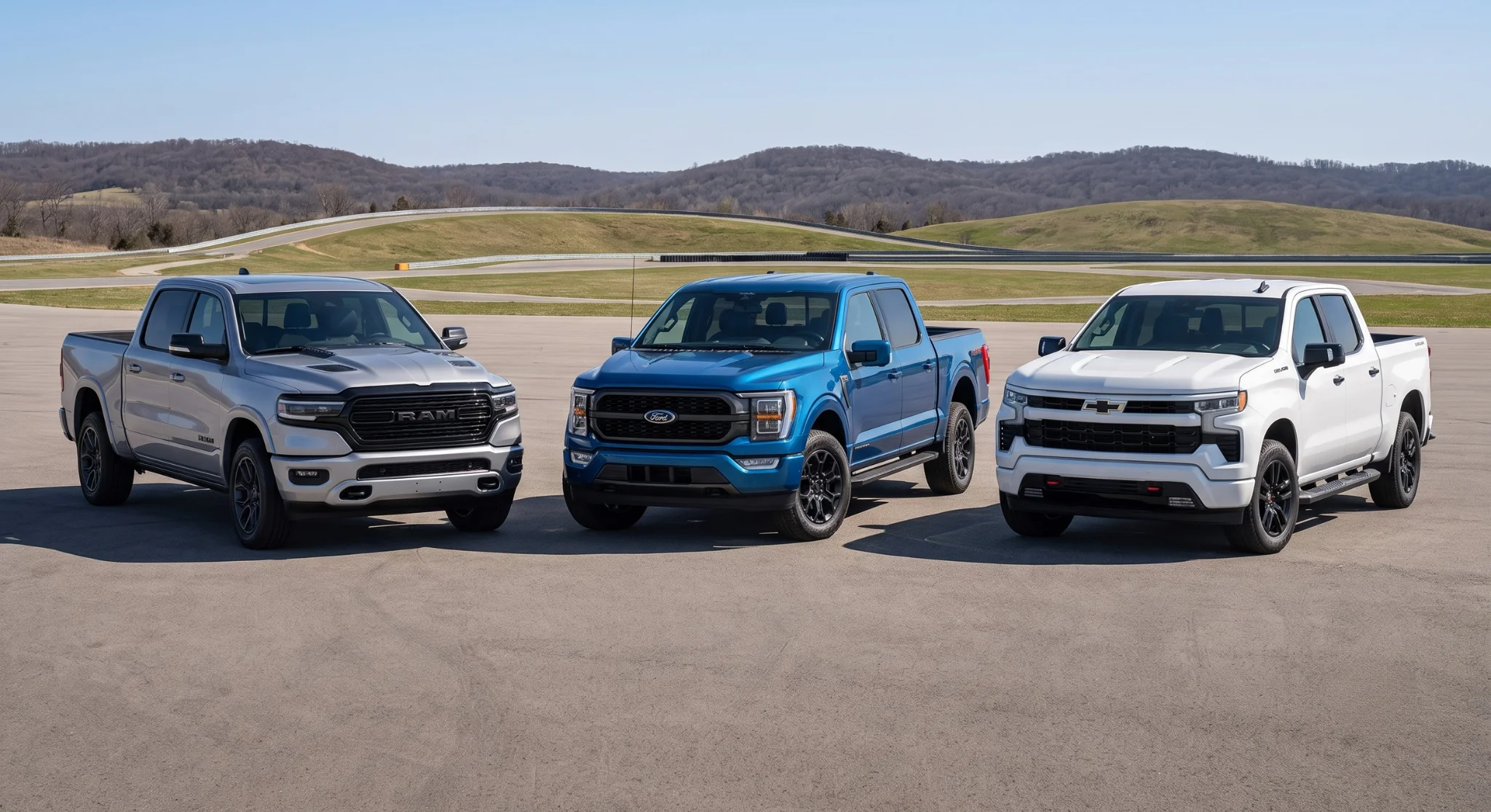
Choosing a full-size pickup in the High Desert comes down to three things: how the truck rides on long commutes, how much it can pull on the weekend, and how far your dollar stretches. This side-by-side compares the 2026 Ram 1500, 2026 Ford F-150, and 2026 Chevrolet Silverado 1500 on ride comfort, capability, and value.
Each takes a different approach. The F-150 leans on capability and its deep powertrain lineup, earning the Kelley Blue Book Best Buy Award for Full-Size Trucks for 2026 (per Kelley Blue Book’s 2026 Best Buy Awards). The Silverado emphasizes work-ready value across a wide range of configurations. The Ram 1500 makes its case on ride quality and cabin refinement — a coil-spring rear suspension and available air suspension that most rivals in this class don’t offer.
Pricing & Value: Where Each Truck Starts
For a fair, apples-to-apples value comparison, the cleanest starting point is each truck’s high-volume mid-grade trim in a Crew Cab, with destination included. These are the trims most buyers actually shop — and where the comfort and technology features covered below start to appear — so comparing them trim-for-trim keeps the numbers meaningful. Here’s how the three stack up.
| Truck | Mid-Grade Crew Cab Trim | Starting MSRP* (destination included) |
|---|---|---|
| Ford F-150 | XLT SuperCrew | ~$48,055* |
| Ram 1500 | Big Horn Crew Cab | ~$50,030* |
| Chevrolet Silverado 1500 | LT Crew Cab | ~$50,400* |
Matched trim-for-trim, the three land within roughly $2,300 of each other. The F-150 XLT opens lowest, with the Ram 1500 Big Horn and Silverado LT nearly even just above it. At this level the equipment gap matters more than the sticker gap: the Big Horn is where the Ram’s cabin-refinement story starts to pay off, with available upgrades like the larger Uconnect 5 touchscreen and comfort features that lean into its lounge-like character — a value story that shows up in the cabin rather than on the base sticker.
Ride Comfort: The Rear Suspension Difference
This is the category that most separates the three, and it comes down to one engineering choice.
- Ram 1500: Five-link coil-spring rear suspension, with available Active-Level Four-Corner Air Suspension — a setup Ram markets as class-exclusive. Air suspension adds adjustable ride height and automatically levels the truck when a trailer is attached.
- Ford F-150: Traditional leaf-spring rear suspension.
- Chevrolet Silverado: Traditional leaf-spring rear suspension (the off-road ZR2 adds Multimatic DSSV dampers).
Leaf springs are durable and load-proven, which is why both Ford and Chevy stick with them. But on the washboard desert roads and highway expansion joints common around Victorville, a coil-spring rear tends to settle faster and transmit less harshness into the cabin — which is why the Ram earns its reputation for a smoother daily ride. If comfort on long commutes is your top priority, this is the Ram’s strongest argument.
Cabin & Comfort Features
Beyond the suspension, interior comfort is where the Ram 1500 concentrates its effort.
| Feature | Ram 1500 | Ford F-150 | Silverado 1500 |
|---|---|---|---|
| Rear seat comfort | Available reclining rear seats (upper Crew Cab trims); ~45.2 in. rear legroom | Spacious SuperCrew; seats 5 | Spacious crew cab |
| Largest available touchscreen | 14.5″ Uconnect 5 | 12″ SYNC 4 (15.5″ available) | 13.4″ with Google Built-In |
| Passenger-side display | Available 10.25″ Front Passenger Interactive Display | Not offered | Not offered |
| In-cabin storage | In-floor storage bins, configurable console | Standard | Standard |
The Ram’s headline comfort features — available reclining rear seats, the available front-passenger interactive display, and the segment’s roomy rear legroom — give it a genuinely more lounge-like cabin than the more utility-focused F-150 and Silverado interiors. All three offer large center touchscreens; only the Ram offers a dedicated passenger screen.
Power & Performance
Each truck offers a broad engine range. Here’s how the core powertrains line up.
Ram 1500 Engines
- 3.6L Pentastar V6 with eTorque (~305 hp) — standard
- 5.7L HEMI® V8 with eTorque (395 hp / 410 lb-ft) — returns for 2026 by customer demand, ~$1,200 option
- 3.0L Hurricane twin-turbo inline-six, standard output (420 hp / 469 lb-ft)
- 3.0L Hurricane high output (540 hp / 521 lb-ft)
Ford F-150 Engines
- 2.7L EcoBoost V6 (325 hp / 400 lb-ft) — standard on lower trims
- 3.5L EcoBoost V6 (382 hp / 500 lb-ft) — standard on Lariat, King Ranch, Platinum
- 5.0L Ti-VCT V8 (400 hp / 410 lb-ft) — available
- 3.5L PowerBoost Hybrid V6 (430 hp / 578 lb-ft) — available
Silverado 1500 Engines
- 2.7L TurboMax I4 (310 hp / 430 lb-ft) — standard
- 5.3L V8 and 6.2L V8 — available
- 3.0L Duramax turbo-diesel — available
The Ram’s Hurricane inline-six is the story here: it delivers V8-rivaling output with turbocharged smoothness, and pairs naturally with the coil-spring ride for a refined driving feel. The F-150’s PowerBoost hybrid and the Silverado’s available Duramax diesel are each strong efficiency-minded alternatives.
Towing Capability
For buyers hauling trailers, toys, or equipment, here are the verified maximum ratings (properly equipped).
| Truck | Max Towing | Engine to Achieve It |
|---|---|---|
| Ford F-150 | 13,500 lbs | 3.5L EcoBoost V6 |
| Chevrolet Silverado 1500 | 13,300 lbs | 6.2L V8 or 3.0L Duramax |
| Ram 1500 | 11,610 lbs | Standard-output Hurricane I6 |
Straight talk: the F-150 leads on peak towing, with the Silverado close behind. The Ram trails on the top number — but its available air suspension self-levels under a heavy trailer, maintaining steering feel and headlight aim, and its ride-comfort advantage holds whether the bed is empty or loaded. If your priority is maximum trailer weight, the F-150 wins the spec. If it’s how the truck feels every other day of the week, the Ram makes its case.
Technology & Safety
All three trucks come well-equipped with driver assistance and modern infotainment. Here’s how the key features compare.
| Feature | Ram 1500 | Ford F-150 | Silverado 1500 |
|---|---|---|---|
| Standard driver-assist suite | Adaptive cruise, lane-keep assist, blind-spot monitoring with trailer coverage — standard across the lineup | Ford Co-Pilot360: automatic emergency braking, blind-spot monitoring with trailer coverage, lane-keeping | Chevy Safety Assist: automatic emergency braking, lane-keep, following-distance indicator |
| Hands-free highway driving | Available | Available BlueCruise (7-year one-time purchase on equipped trucks) | Available Super Cruise |
| Largest available touchscreen | 14.5″ Uconnect 5 | 12″ SYNC 4 (15.5″ available) | 13.4″ with Google Built-In (LT and up) |
| Premium audio | Available 23-speaker Klipsch (top trims) | Available Bang & Olufsen (up to 18 speakers) | Available Bose 7-speaker (upper trims) |
| NHTSA overall safety rating | 5 stars (Quad Cab); 4 stars (Crew Cab) | 5 stars | 5 stars (Regular/Extended Cab; Crew Cab not yet rated) |
All three are strong on safety. The Ram’s edge is that its core driver-assist features are standard across the whole lineup, so you don’t have to climb the trim ladder to get them.
Which 2026 Truck Is Right for You?
- Choose the Ram 1500 if ride comfort, cabin refinement, and standard driver-assist tech top your list — especially for long High Desert commutes where the coil-spring and available air suspension pay off every day.
- Choose the Ford F-150 if maximum towing capability and the widest powertrain menu are your priorities — and it opens at the lowest price of the three in mid-grade Crew Cab form.
- Choose the Silverado 1500 if a broad, work-focused configuration range and Chevy’s wide trim ladder matter most.
For drivers around Victorville, Hesperia, Apple Valley, and Phelan who spend real time behind the wheel, the Ram 1500’s combination of a smoother ride and a more comfortable cabin is what tends to win people over — without giving up the capability a full-size truck needs.
Frequently Asked Questions
Is the 2026 Ram 1500 worth it over the F-150 and Silverado?
For buyers who use their truck as a daily driver and family vehicle, the Ram 1500 makes a strong case. Its coil-spring rear suspension and available air suspension deliver a smoother, more composed ride that reduces fatigue on long commutes, and its cabin is among the most refined in the segment. The F-150 and Silverado remain highly capable — the F-150 in particular leads on maximum towing — so the right pick depends on whether you prioritize ride comfort or peak capability.
Which truck has the most comfortable cabin for long road trips?
The Ram 1500 is widely praised for cabin comfort. Its crew cab offers roomy rear legroom (about 45.2 inches), available reclining rear seats on upper trims, and premium materials. The F-150 and Silverado offer spacious, well-built cabins, but their interiors lean more utilitarian.
How does towing compare across these trucks?
Properly equipped, the F-150 tows up to 13,500 lbs (3.5L EcoBoost V6), the Silverado up to 13,300 lbs (6.2L V8 or Duramax diesel), and the Ram 1500 up to 11,610 lbs (standard-output Hurricane inline-six). The F-150 leads on the top number; the Ram counters with air suspension that self-levels under a trailer for added towing confidence.
Do these trucks offer bed-mounted power outlets?
Yes. The F-150 offers Pro Power Onboard (up to 2 kW, or 7.2 kW on hybrid Platinum Plus configurations). The Ram 1500 and Silverado 1500 also offer bed-mounted electrical outlets suited to tools, tailgating, and recreational gear.
Disclaimers
Pricing: Manufacturer’s Suggested Retail Price (MSRP) for new vehicles includes manufacturer and distributor options and delivery, process and handling fees, which may be subject to change at any time. MSRP excludes taxes, title, license and dealer installed options, accessories, fees and charges. MSRP is not the dealer advertised price. Dealer price will vary. The dealer sets the final price.
Towing & payload: Maximum towing and payload capacity figures are based on properly equipped vehicles and vary by configuration. Do not exceed any weight rating. See your owner’s manual and the vehicle’s door-jamb label for specific capacities.
Safety ratings & specifications: NHTSA overall safety ratings and audio configurations per NHTSA (nhtsa.gov/ratings), U.S. News, and Kelley Blue Book, current as of publication. Ratings vary by cab configuration and are subject to change.