






2026 Jeep Wrangler vs 2026 Toyota 4Runner | Victorville Comparison
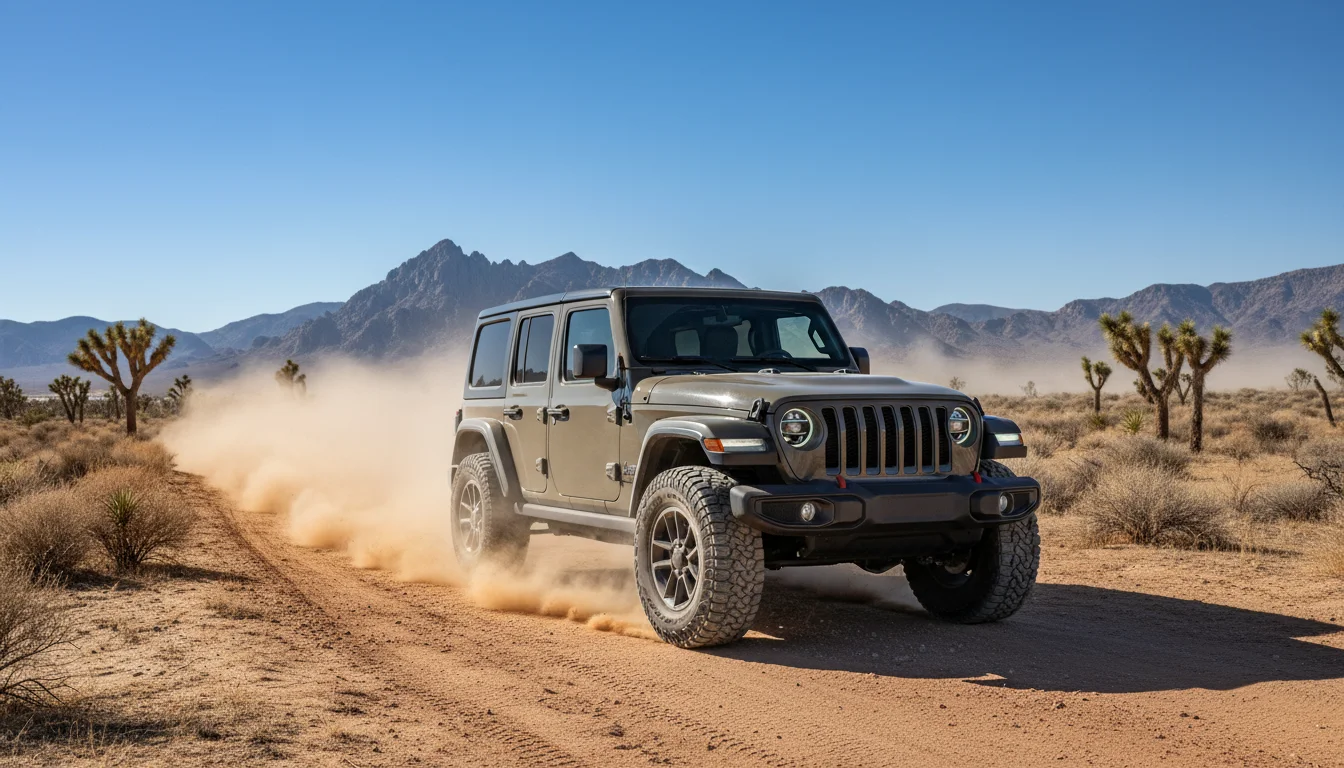
When it comes to conquering the High Desert, the 2026 Jeep Wrangler delivers what Victorville drivers need most: purpose-built off-road hardware, open-air freedom, and a starting price thousands below the competition. The 2026 Toyota 4Runner brings its own strengths to the table, but for families and adventurers who prioritize trail-ready capability and value, the Wrangler makes a compelling case.
Below, we break down the key differences across performance, capability, comfort, safety, and value so High Desert shoppers — from Hesperia tradespeople to Apple Valley families — can see exactly how these two SUVs stack up. Explore the full 2026 Jeep Wrangler lineup at Victorville Motors to see every available trim and configuration.
Power and Performance
| Specification | 2026 Jeep Wrangler | 2026 Toyota 4Runner |
|---|---|---|
| Engine | 3.6L Pentastar V6 | i-FORCE 2.4L Turbocharged 4-Cylinder |
| Horsepower | 285 hp | 278 hp |
| Torque | 260 lb-ft | 317 lb-ft |
| Transmission | 8-speed automatic (6-speed manual available) | 8-speed automatic |
| Drivetrain | Command-Trac Part-Time 4×4 (standard) | RWD or Part-time 4WD |
The 2026 Jeep Wrangler’s proven 3.6L Pentastar V6 delivers a class-competitive 285 horsepower and 260 lb-ft of torque — enough muscle for highway commuting and serious off-road trails around the San Bernardino National Forest. Paired with a smooth-shifting 8-speed automatic transmission, the Wrangler delivers confident power delivery whether you’re merging onto I-15 or navigating technical desert terrain. A 6-speed manual is also available for enthusiasts who prefer a traditional driving experience.
More importantly, the Wrangler comes standard with Command-Trac part-time 4×4 on every trim — no upcharge, no package required. Add available features like the electronic sway bar disconnect, front and rear locking differentials, and a best-in-class 100:1 crawl ratio on the Rubicon, and the Wrangler’s off-road hardware depth is unmatched. The 4Runner offers an electronic locking rear differential on TRD Off-Road trims and above, but it requires climbing to higher (and pricier) trim levels to access comparable trail capability.
The 4Runner’s i-FORCE 2.4L turbocharged four-cylinder counters with 278 horsepower and a stronger 317 lb-ft of torque, giving it an edge in low-end pulling power. An available i-FORCE MAX hybrid adds 326 horsepower and 465 lb-ft. These are respectable numbers, but they come packaged in a heavier vehicle (~4,685 lbs vs. the Wrangler’s ~4,012–4,285 lbs) that doesn’t match the Wrangler’s mechanical off-road depth at comparable price points.
For those upgrading their current vehicle, check your trade-in value to see what your ride is worth.
Off-Road Design and Exterior
This is where the Wrangler separates itself entirely. No other production SUV offers what the Jeep Wrangler does: quick-release door hinges (improved for 2026), removable roof panels, and a fold-down windshield that transform it into a true open-air vehicle. The 4Runner is a capable SUV, but it’s a closed-roof vehicle with no modular body options — a fundamentally different experience for Victorville drivers who live for the desert sun and open trails.
The Wrangler’s compact 73.9-inch width and 166.8-inch length (2-door) give it agility on narrow desert trails that the 4Runner’s wider 77.9-inch body and 194.9-inch length cannot match. For navigating tight switchbacks near Phelan or threading through rocky washes around Adelanto, the Wrangler’s proportions are purpose-built for the terrain.
The Sport S trim adds a Corning Gorilla Glass windshield — engineered to resist the flying rocks and desert grit that come with serious off-roading. Upgraded trims bring available 35-inch all-terrain tires with beadlock-capable rims, purpose-built for loose sand, rocky terrain, and steep High Desert inclines. The Wrangler also offers durable steel bumpers and a factory-installed Warn winch — real tools for real off-road scenarios, not just styling cues.
The 4Runner’s TRD Off-Road and Trailhunter trims offer suspension upgrades and electronic trail aids, and its available 20-inch alloy wheels cut a strong on-road presence. But for drivers who want a vehicle that’s as modular and trail-adaptable as their lifestyle, the Wrangler stands alone.
Interior Comfort and Cargo Space
| Specification | 2026 Jeep Wrangler | 2026 Toyota 4Runner |
|---|---|---|
| Seating Capacity | 4 (2-Door) / 5 (4-Door) | 5 (optional 7 on SR5/Limited) |
| Cargo Volume (Max) | 31.7 cu ft (2-Door) / 72.4 cu ft (4-Door) | 90.2 cu ft |
| Cargo Behind 2nd Row | 12.9 cu ft (2-Door) / 31.7 cu ft (4-Door) | 48.4 cu ft |
| Curb Weight | ~4,012 lbs (2-Door) / ~4,285 lbs (4-Door) | ~4,685 lbs |
| Overall Length | 166.8 in (2-Door) / 188.4 in (4-Door) | 194.9 in |
The Wrangler’s four-door model delivers 72.4 cubic feet of cargo space with seats folded — more than enough for family outings to Mojave Narrows Regional Park, camping gear for a weekend in the High Desert, or hauling equipment after a day on dusty Victorville roads. Its real cargo advantage is versatility: removable doors, fold-down windshield, and rear in-floor storage bins create a flexible, adventure-ready hauling experience that no traditional SUV can replicate.
The 4Runner offers more raw volume — 90.2 cubic feet maximum and 48.4 behind the second row — and available third-row seating on SR5 and Limited trims expands capacity to seven passengers. For families who routinely need maximum cargo volume or extra seating, the 4Runner has the edge in sheer space. However, that extra size comes with a heavier curb weight (~4,685 lbs) and a larger footprint that’s less maneuverable in tight trail situations and suburban parking.
Inside, the Wrangler offers available heated front seats, an 8-way power-adjustable driver’s seat, and durable cloth or premium leather trim built to handle the wear of an active outdoor lifestyle. Both cabins are comfortable for daily commuting through Apple Valley and Lucerne Valley, but the Wrangler’s interior is designed with the understanding that its owners will track in trail dust — and that’s a feature, not a flaw.
Technology and Connectivity
The Wrangler wins on technology value. Its standard 12.3-inch Uconnect 5 touchscreen is included on every trim — even the base Sport — with wireless Apple CarPlay and Android Auto, giving drivers a premium tech experience from the entry-level price point. The 4Runner starts with a smaller 8-inch touchscreen on the SR5, reserving its 14-inch display for pricier trims like the TRD Sport Premium and above. To get the 4Runner’s best screen, you’re paying significantly more than a comparably equipped Wrangler.
The Wrangler rounds out its tech package with an integrated 4G LTE Wi-Fi hotspot, over-the-air software updates, and an optional Alpine premium audio system with nine speakers and a subwoofer — features that keep drivers connected whether they’re commuting through Hesperia or heading off-grid for the weekend. The 4Runner’s JBL 14-speaker system is impressive but requires moving up to the TRD Sport Premium or Limited trim, adding to overall cost.
For daily drives to the Route 66 Museum or weekend escapes into the desert, the Wrangler delivers a more complete tech package at a lower buy-in.
Safety Features
The Wrangler Sport S and above come equipped with a comprehensive safety suite: full-speed Forward Collision Warning Plus, Adaptive Cruise Control with Stop, Blind Spot Monitoring, Rear Cross Path Detection, and the ParkView Rear Backup Camera with Dynamic Grid Lines. For families navigating Hesperia’s suburban streets and Victorville’s busy intersections, these features provide real daily driving confidence.
The 4Runner includes Toyota Safety Sense 3.0 standard on every trim, giving it broader base-level ADAS coverage — an advantage for buyers who plan to stick with the base SR5. Both vehicles offer blind spot monitoring and rear cross-traffic alerts.
Where the Wrangler adds a dimension the 4Runner cannot is structural off-road safety. Reinforced frame rails enhance crash protection and reduce rollover risk, and supplemental side-curtain and front seat-mounted airbags provide layered protection. For High Desert drivers who split time between paved roads and challenging trails around Phelan and Adelanto, the Wrangler’s combination of electronic and structural safety is designed for the full spectrum of conditions these families actually encounter.
Fuel Economy and Towing Capacity
| Specification | 2026 Jeep Wrangler | 2026 Toyota 4Runner |
|---|---|---|
| City MPG | 17 mpg | 20 mpg |
| Highway MPG | 23 mpg | 26 mpg |
| Combined MPG | 19 mpg | 22 mpg |
| Max Towing Capacity | Up to 5,000 lbs (select Rubicon 4-Door) | 6,000 lbs |
The Wrangler delivers an EPA-estimated 17 city / 23 highway / 19 combined mpg with its V6 and 8-speed automatic — solid efficiency for a body-on-frame 4×4 with standard four-wheel drive and true off-road capability. For context, the Wrangler achieves this while weighing 400–600 pounds less than the 4Runner, which contributes to more responsive handling on the trail and at the pump in real-world driving around Victorville. Drivers who opt for the available 2.0L turbocharged four-cylinder (standard on the Sahara) can achieve an EPA-estimated 21 mpg combined.
The 4Runner achieves a better EPA rating of 22 mpg combined (20 city / 26 highway) with its turbocharged four-cylinder. That 3-mpg gap is a consideration for high-mileage commuters, though the Wrangler’s available turbo engine narrows that difference to just 1 mpg combined.
For towing, the 4Runner is rated at 6,000 pounds across all trims. The Wrangler’s towing varies by configuration: 2,000 pounds for two-door models, 3,500 for most four-door models, and up to 5,000 pounds on select Rubicon four-door models when properly equipped. The 4Runner has the advantage for heavy-load highway towing.
But towing numbers only tell part of the story. The Wrangler’s available front and rear locking differentials and sway bar disconnect give it a decisive advantage when towing on the rough, uneven terrain that’s common around Adelanto and Phelan. Pulling a trailer down a paved highway is one thing — pulling one down a rocky desert trail is another, and that’s where the Wrangler’s hardware earns its keep.
Pricing and Value
| Specification | 2026 Jeep Wrangler | 2026 Toyota 4Runner |
|---|---|---|
| Starting MSRP | $33,785 (Sport 2-Door) | $41,870 (SR5) |
Pricing per Edmunds; includes destination charges. Actual pricing may vary.
This is the Wrangler’s knockout punch. The Sport 2-Door starts at approximately $33,785 — over $8,000 less than the base 4Runner SR5. Even the four-door Sport at approximately $36,990 still undercuts the 4Runner by nearly $5,000 while adding a fifth seat and substantially more cargo space. The Sport S 2-Door at approximately $38,035 adds adaptive cruise control and Forward Collision Warning — a well-equipped safety package at a price point where you haven’t even reached the 4Runner’s base model.
The gap widens at higher trims. The 4Runner TRD Off-Road Premium starts at approximately $56,070, while the Wrangler Willys offers serious off-road gear — 33-inch all-terrain tires, rear axle locker, and Command-Trac 4×4 — at a significantly lower price. For Victorville’s working families, this means getting trail-ready capability, modern technology, and a vehicle that holds its value exceptionally well, all without stretching the budget.
Browse the new Jeep Wrangler inventory at Victorville Motors to see current availability and pricing.
Warranty Coverage
| Specification | 2026 Jeep Wrangler | 2026 Toyota 4Runner |
|---|---|---|
| Basic Warranty | 3 years / 36,000 miles | 3 years / 36,000 miles |
| Powertrain Warranty | 5 years / 60,000 miles | 5 years / 60,000 miles |
| Roadside Assistance | 5 years / 60,000 miles | 2 years / unlimited miles |
Both SUVs match on basic and powertrain coverage. The Wrangler pulls ahead where it matters most for High Desert adventurers: roadside assistance. Jeep covers you for five years and 60,000 miles versus Toyota’s two years. When you’re exploring remote trails near Phelan or camping off-grid past Adelanto, knowing you have extended roadside support isn’t just convenient — it’s essential.
Frequently Asked Questions
Is the 2026 Jeep Wrangler worth the price difference compared to the Toyota 4Runner?
Absolutely. The Wrangler starts approximately $8,000 below the base 4Runner and includes off-road hardware like available locking differentials, electronic sway bar disconnect, and the Trail Rated badge that the 4Runner doesn’t offer at any price. Add in open-air freedom with removable doors and roof panels, and the Wrangler delivers more trail-ready capability and customization per dollar than the 4Runner. For High Desert families who value rugged versatility, it’s one of the strongest values in the segment.
Which vehicle delivers better fuel economy for daily driving in Victorville?
The 4Runner’s turbocharged four-cylinder achieves an EPA-estimated 22 mpg combined versus the Wrangler’s 19 mpg combined with its standard V6 and 8-speed automatic. Drivers who opt for the Wrangler Sahara’s available 2.0L turbo engine can close that gap to just 1 mpg with a 21 mpg combined rating. For most Victorville drivers, the modest difference is a reasonable trade-off for the Wrangler’s superior off-road capability and standard 4×4 hardware.
Which vehicle provides more cargo space for families and outdoor gear?
The 4Runner offers more total volume — 90.2 cubic feet with seats folded versus the Wrangler four-door’s 72.4 cubic feet. However, the Wrangler’s modular design with removable roof panels, doors, and fold-down windshield creates a uniquely versatile cargo experience that traditional SUVs can’t match. For most family outings and weekend gear hauling, the Wrangler’s 72.4 cubic feet is more than sufficient, and the open-air flexibility adds a dimension the 4Runner simply doesn’t have.
What about towing capacity differences between the two SUVs?
The 4Runner tows up to 6,000 pounds, while the Wrangler reaches up to 5,000 pounds on select Rubicon four-door models (3,500 for most four-door models, 2,000 for two-door). The 4Runner has the edge for heavy highway towing. The Wrangler’s advantage is towing capability on rough terrain — its available locking differentials and sway bar disconnect help manage loads on the uneven trails that are common in the High Desert, where raw tow rating matters less than traction and control.
How do safety features compare for families in the Victorville area?
The 4Runner includes Toyota Safety Sense 3.0 standard on all trims, while the Wrangler’s advanced driver assistance features (adaptive cruise, forward collision warning, blind spot monitoring) are standard from the Sport S trim upward. The Wrangler adds structural off-road safety features — reinforced frame rails and electronic roll mitigation — that provide an extra layer of protection for families who drive both paved roads and challenging desert trails.
Visit Victorville Motors for Your 2026 Jeep Wrangler
The 2026 Jeep Wrangler combines 285 horsepower, purpose-built off-road hardware, open-air freedom, and a starting price over $8,000 below the 4Runner — a combination no competitor can match. Whether you choose the nimble 2-door Sport or the more spacious 4-door Sport S with available adaptive cruise control and the TrailCam off-road camera, Victorville Motors is ready to help you find the right Wrangler for your High Desert lifestyle.
Visit us at 14617 Civic Dr, Victorville, CA 92394. Learn more about the 2026 Jeep Wrangler or explore our full new vehicle inventory.