






2026 Jeep Grand Cherokee vs. Toyota 4Runner: Which Midsize SUV Fits High Desert Life?
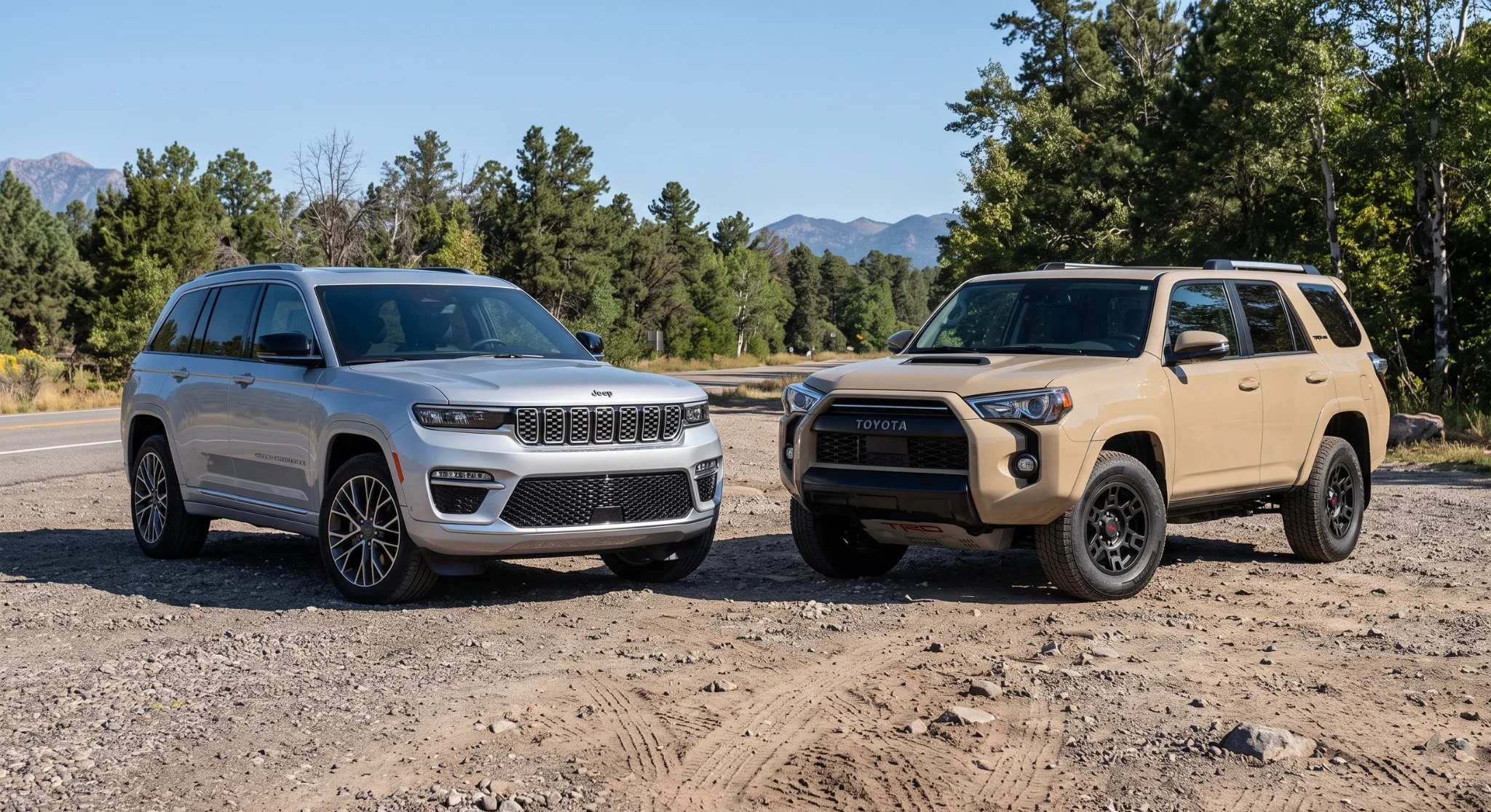
Shoppers across Victorville and the wider High Desert often cross-shop the 2026 Jeep Grand Cherokee and the 2026 Toyota 4Runner. Both are capable midsize SUVs, but they are built on opposite philosophies—and that difference decides which one fits your driving. This side-by-side breaks down engineering, power, price, interior space, technology, and safety so you can decide with facts, not marketing.
If your week is mostly pavement—commuting, school runs, errands—with weekend trips folded in, the Grand Cherokee’s on-road refinement is the reason most High Desert families land on it. You can view current stock anytime on our 2026 Grand Cherokee inventory page, or explore related model guides in our CDJR research hub.
At a Glance
| Attribute | 2026 Jeep Grand Cherokee | 2026 Toyota 4Runner |
|---|---|---|
| Construction | Unibody | Body-on-frame (TNGA-F, shared with Tacoma) |
| Ride character | Car-like, quiet, refined on-road manners | Truck-based toughness, firmer ride, taller step-in |
| Best suited for | Daily driving and highway comfort with weekend capability | Off-road-focused adventure and trail use |
| Capability system | Available Quadra-Trac 4×4 | Available/standard part-time & full-time 4WD |
Engine, Power & Towing
Both SUVs offer turbocharged four-cylinders, but they position them differently: on the Grand Cherokee it is the uplevel engine that sits above the base V6, while every gas 4Runner uses one as standard.
| Specification | 2026 Jeep Grand Cherokee | 2026 Toyota 4Runner |
|---|---|---|
| Standard engine | 3.6L Pentastar V6 (293 hp) | 2.4L i-FORCE Turbo (278 hp) |
| Uplevel engine | 2.0L Hurricane Turbo 4 (324 hp / 332 lb-ft) | i-FORCE MAX Hybrid (326 hp / 465 lb-ft) |
| Transmission | 8-speed automatic | 8-speed automatic |
| Standard drivetrain | RWD (4×4 available) | RWD on select trims (4WD available/standard elsewhere) |
| Max towing (properly equipped) | 6,200 lbs | 6,000 lbs gas / 5,800 lbs hybrid top trims |
| EPA-Estimated fuel economy | 21 city / 26 hwy / 23 combined (Hurricane 4×4) | 20 city / 26 hwy / 22 combined (gas RWD) |
On the Grand Cherokee, the base Laredo and Laredo X use the 3.6L Pentastar V6, while the 2.0L Hurricane Turbo 4 (324 hp) becomes standard from the Laredo Altitude package up through Limited, Limited Reserve, 85th Anniversary Edition, and Summit. Every gas 4Runner runs the 2.4L i-FORCE, with an available i-FORCE MAX hybrid standard on Platinum, TRD Pro, and Trailhunter. At the top of each lineup, though, the 4Runner’s available i-FORCE MAX hybrid makes the most power and torque in this matchup—326 hp and 465 lb-ft, ahead of the Hurricane’s 324 hp and 332 lb-ft, with the widest gap in torque.
When properly equipped, the Grand Cherokee tows up to 6,200 lbs with either engine—consistent across the lineup. The 4Runner tows 6,000 lbs on gas trims; its i-FORCE MAX hybrid top trims (Platinum, TRD Pro, Trailhunter) are rated at 5,800 lbs due to added equipment weight. Either handles a small boat, utility trailer, or ATV carrier—the Jeep simply carries a modest edge at the top.
EPA-estimated fuel economy figures are for comparison purposes only. Your actual mileage will vary depending on driving conditions, how you drive and maintain your vehicle, battery age/condition, and other factors.
Edge: Grand Cherokee
Higher gas-engine horsepower (324 vs 278) and a slight towing advantage, with RWD-or-4×4 flexibility—though the 4Runner’s available i-FORCE MAX hybrid leads on outright output (326 hp / 465 lb-ft).
Pricing
Pricing reflects the two brands’ positioning. Figures below are starting MSRP with destination included.
| Vehicle | Trim | Starting MSRP |
|---|---|---|
| 2026 Jeep Grand Cherokee | Laredo (base) | ~$38,920 |
| 2026 Jeep Grand Cherokee | 85th Anniversary Edition | $46,320 |
| 2026 Toyota 4Runner | SR5 (base) | $42,070 |
| 2026 Toyota 4Runner | Limited | $56,700 |
| 2026 Toyota 4Runner | Platinum | $64,160 |
The Grand Cherokee opens roughly $3,000 below the 4Runner’s entry point, and the gap widens as you climb into comparably equipped trims. For High Desert families weighing everyday value against upfront cost, that entry-price advantage matters.
Manufacturer’s Suggested Retail Price (MSRP) for new vehicles includes manufacturer and distributor options and delivery, process and handling fees, which may be subject to change at any time. MSRP excludes taxes, title, license and dealer installed options, accessories, fees and charges. MSRP is not the dealer advertised price. Dealer price will vary. The dealer sets the final price.
Edge: Grand Cherokee
Lower starting MSRP and stronger price-to-equipment value at comparable trims.
Interior Space & Cargo
The two take different approaches to hauling people and gear.
| Specification | 2026 Jeep Grand Cherokee | 2026 Toyota 4Runner |
|---|---|---|
| Seating | 5 | 5 (7 available on gas SR5 & Limited) |
| Cargo behind 2nd row | 37.7 cu ft | 48.4 cu ft (gas) |
| Max cargo (2nd row folded) | 70.8 cu ft | ~90 cu ft (2-row) |
| Curb weight | ~4,238 lbs | 4,685 lbs (SR5 4WD) |
The 4Runner prioritizes raw box volume, expanding to about 90 cu ft with the seats folded, and offers an available third row (gas SR5 and Limited) that seats seven—though cargo drops to 12.1 cu ft with all three rows up, and its body-on-frame design means a taller cargo floor. The Grand Cherokee focuses on a lower, flatter, more accessible load floor and a more refined, near-luxury cabin in a five-passenger, two-row layout.
Edge: Split Decision
4Runner for maximum cargo volume and available seven-seat capacity; Grand Cherokee for load-floor accessibility and cabin refinement.
Technology
Both cabins scale technology by trim.
- Grand Cherokee: Base Laredo/Laredo X use an 8.4-inch screen; from the Altitude package up, a 12.3-inch Uconnect 5 NAV touchscreen becomes standard, with wireless Apple CarPlay and Android Auto, available Wi-Fi hotspot, and wireless charging. Upper trims add a configurable digital gauge cluster and available premium audio.
- 4Runner: An 8-inch touchscreen is standard, stepping up to a 14-inch Toyota Audio Multimedia display and available 14-speaker JBL Premium Audio on higher trims. A 12.3-inch digital gauge cluster arrives from the TRD Sport up. Wireless Apple CarPlay and Android Auto are standard across the line.
Edge: Even
The 4Runner offers a larger available 14-inch touchscreen and standard wireless Apple CarPlay and Android Auto across the entire lineup, while the Grand Cherokee counters with its 12.3-inch Uconnect 5 and a more upscale, near-luxury cabin presentation. The better fit comes down to whether you prioritize screen size or cabin polish.
Safety & Driver Assistance
Both bring strong standard driver-assistance suites.
- Grand Cherokee comes standard for 2026 with Active Lane Management, blind-spot monitoring, rear cross-traffic detection, and automated emergency braking, with available Hands-Free Active Driving Assist and a surround-view camera on upper trims.
- 4Runner includes Toyota Safety Sense 3.0 on every trim—pre-collision with pedestrian detection, adaptive cruise, lane-departure alert with steering assist, lane-centering, and road-sign recognition—plus standard blind-spot monitoring with rear cross-traffic alert. A Multi-Terrain Monitor and 360-degree views arrive on upper trims.
Both are well-equipped; the practical difference is trim-level packaging rather than one lacking a core safety net.
Edge: Even
Both offer robust standard active safety.
The Verdict for High Desert Drivers
For buyers who spend most of their miles on Victorville-area streets and highways—with weekend getaways in the mix—the 2026 Jeep Grand Cherokee is the better all-around fit. It delivers a quieter, more refined unibody ride, higher gas-engine horsepower, a slight towing edge, a more upscale cabin on mainstream trims, and a lower price of entry. The 4Runner remains a genuinely capable, off-road-focused, resale-strong choice—with a larger touchscreen, more outright hybrid power, and available seven-seat versatility—but its truck-based ride, taller step-in, and higher pricing make it a more specialized pick.
If the Grand Cherokee sounds like your match, the team at Victorville Motors can help you find the right trim and configuration.
Frequently Asked Questions
Is the 2026 Jeep Grand Cherokee better for daily commuting than the Toyota 4Runner?
For most daily drivers, yes. The Grand Cherokee’s unibody construction delivers a smoother, quieter, more car-like ride. The 4Runner’s body-on-frame platform is built for off-road durability, which brings a firmer ride and higher step-in height.
Which SUV tows more?
The Grand Cherokee, by a modest margin. Properly equipped, it tows up to 6,200 lbs. The 4Runner tows up to 6,000 lbs on gas trims and 5,800 lbs on its hybrid top trims.
Which one is more affordable?
The Grand Cherokee starts lower—around $38,920 MSRP for the base Laredo versus $42,070 for the 4Runner SR5—and holds a value edge through comparable trims.
Does the 4Runner offer more cargo space?
Yes, in raw volume: 48.4 cu ft behind the second row versus the Grand Cherokee’s 37.7 cu ft. The 4Runner also offers available third-row seating on gas SR5 and Limited trims. The Grand Cherokee counters with a lower, flatter, more accessible load floor.
Disclaimers
EPA-estimated fuel economy figures are for comparison purposes only. Your actual mileage will vary depending on driving conditions, how you drive and maintain your vehicle, battery age/condition, and other factors.
Manufacturer’s Suggested Retail Price (MSRP) for new vehicles includes manufacturer and distributor options and delivery, process and handling fees, which may be subject to change at any time. MSRP excludes taxes, title, license and dealer installed options, accessories, fees and charges. MSRP is not the dealer advertised price. Dealer price will vary. The dealer sets the final price.