







2026 Dodge Charger Daytona Trims and Performance
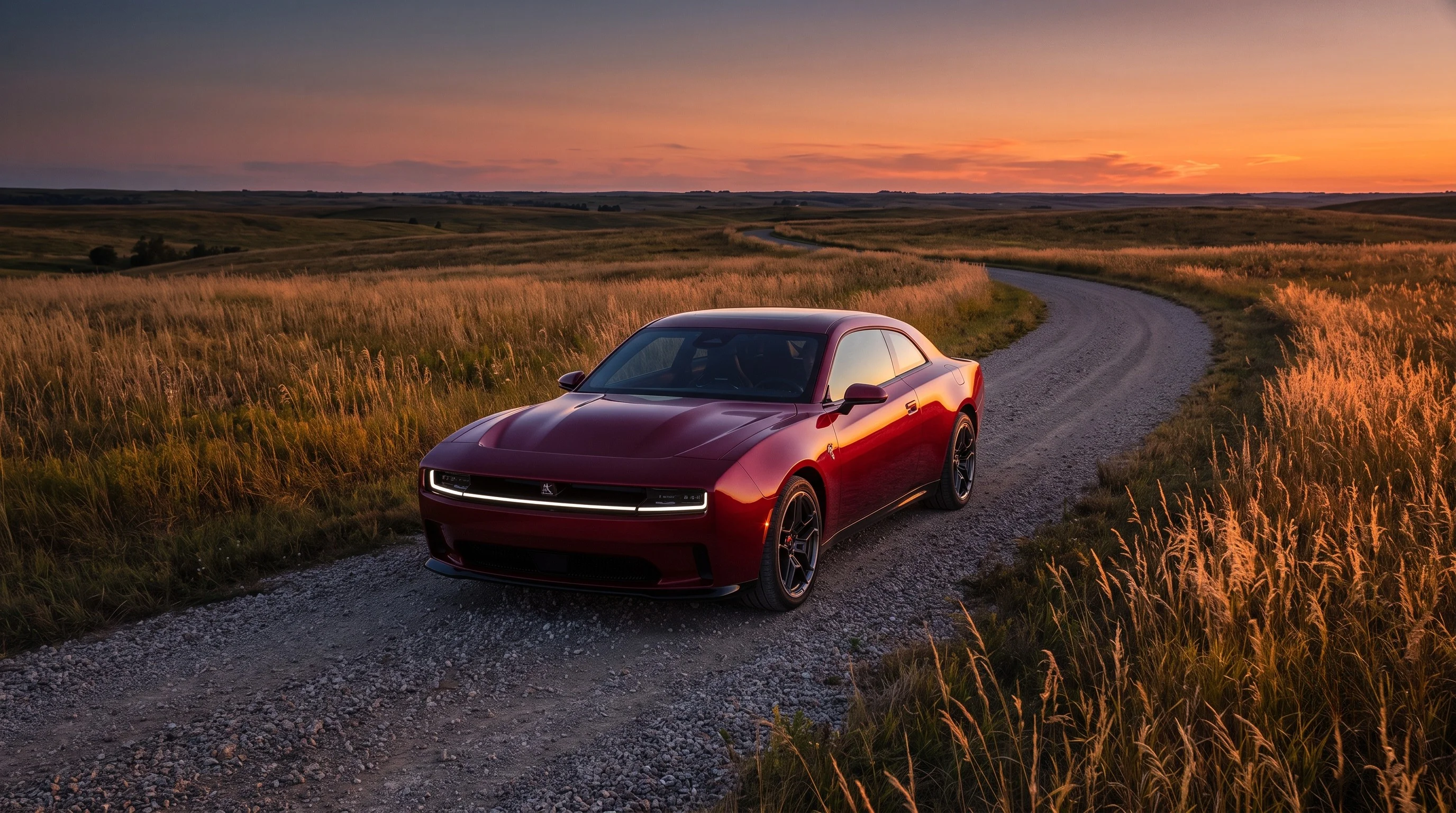
American muscle has entered its electric era. The 2026 Dodge Charger Daytona is Victorville Motors’ front-row seat to it. It rides on a dual-motor platform with standard all-wheel drive, and it can switch to rear-wheel drive at the push of a button. That setup delivers the instant torque and straight-line authority muscle-car drivers expect, now without a combustion engine. For 2026, the all-electric Daytona is available in two body styles. You can choose the two-door coupe or, for the first time, a four-door sedan. The sedan keeps the coupe’s wide-body proportions and adds a liftgate-style rear opening for everyday practicality.
Inside, the cockpit has been reimagined around the driver. A freestanding digital cluster pairs with a 12.3-inch Uconnect® 5 touchscreen. Heritage touches remain, including the classic pistol-grip shifter. Available 64-color Attitude Adjustment lighting reacts to drive-mode changes and other vehicle events.
The 2026 Charger Daytona Lineup: Scat Pack and Scat Pack Plus
For 2026, the all-electric Charger Daytona lineup is built entirely around the Scat Pack. It comes in two grades: Scat Pack and the better-equipped Scat Pack Plus. Both are available as a two-door coupe or a four-door sedan. Every 2026 Charger Daytona shares the same 670-horsepower electric powertrain and standard all-wheel drive. So the choice between grades comes down to comfort, technology, and appearance rather than raw output.
| Feature | Scat Pack | Scat Pack Plus |
|---|---|---|
| Electric Powertrain | 630 hp standard / 670 hp with PowerShot, 627 lb-ft, standard AWD | Identical — 630 hp standard / 670 hp with PowerShot, 627 lb-ft, standard AWD |
| Body Styles | Two-door coupe & four-door sedan | Two-door coupe & four-door sedan |
| Seating | Performance front seats | High-back, heated and ventilated leather-and-suede power performance seats |
| Comfort & Tech | 12.3-inch Uconnect 5 and digital cluster; available Attitude Adjustment lighting | Adds available wireless phone charging and Alpine premium audio |
| Available Packages | Track Package, Blacktop® Package | Adds the Carbon & Suede Package and available panoramic glass roof |
| Positioning | Core electric muscle | Top comfort and technology grade; the most accessible path into the Track Package |
Because both grades run the same dual-motor setup, a Scat Pack and a Scat Pack Plus accelerate identically. Scat Pack Plus is the step up for buyers who want more. It adds premium seating, extra lighting and appearance content, and the available Carbon & Suede and panoramic-glass-roof options.
Performance: Instant, Repeatable Muscle
Straight-line speed is where the Charger Daytona makes its case. In normal driving, the dual-motor system produces 630 horsepower. Press the steering-wheel PowerShot button and output jumps to 670 horsepower and 627 lb-ft of torque. That burst lasts 10 seconds and can be used again and again. With all-wheel-drive traction off the line, the Scat Pack sprints from 0 to 60 mph in 3.3 seconds. It covers the quarter mile in about 11.5 seconds, quicker than the previous generation’s supercharged V8 flagship. These figures come from Dodge’s official Charger specifications.
Top speed is electronically limited to about 134 mph. Dodge tuned the Scat Pack for the quickest launch and quarter-mile rather than top-end running. Drivers who want to sharpen things further can add the Track Package. It brings Launch Control and a Dual-Valve Adaptive Damping System, along with track-oriented braking and wheel-and-tire hardware.
| Specification | Detail |
|---|---|
| Horsepower | 630 hp standard; 670 hp with PowerShot |
| Torque | 627 lb-ft |
| 0–60 mph | 3.3 seconds |
| Top Speed | About 134 mph (electronically limited) |
| Drivetrain | Dual-motor all-wheel drive (switchable to rear-wheel drive) |
| Battery | 100.5 kWh total (93.9 kWh usable), 400-volt architecture |
| EPA-Estimated Range | 267 miles (standard Scat Pack); 241 miles with the Track Package |
| DC Fast Charging | Up to 183 kW; 20%–80% in about 24 minutes |
| Home Charging | Up to 11 kW Level 2 (overnight full charge) |
Range, Battery, and Charging
The Charger Daytona is powered by a 100.5-kWh battery pack (93.9 kWh usable) on a 400-volt architecture. The standard Scat Pack carries an EPA-estimated 267 miles of range. Adding the Track Package’s wider tires and performance tune drops that to an EPA-estimated 241 miles. Confirm the exact figure on the window sticker for the configuration you’re considering.
When it’s time to plug in, the Charger Daytona accepts DC fast charging at up to 183 kW. That takes the battery from 20% to 80% in about 24 minutes at a compatible high-speed station. At home, an 11-kW Level 2 connection replenishes the pack overnight. Most owners start each day with a full charge.
EPA-estimated fuel economy figures are for comparison purposes only. Your actual mileage will vary depending on driving conditions, how you drive and maintain your vehicle, battery age/condition, and other factors.
Managing High Desert Temperatures and EV Range
Running an EV through Victor Valley summers is straightforward. The key is understanding how climate control affects efficiency. Extreme heat draws energy mainly through cabin cooling. Running the air conditioning at full tilt pulls from the same battery that moves the car, which can modestly reduce range on the hottest days. Compared with the deep-freeze conditions that sap EV range up north, the High Desert’s swings are far kinder to an electric drivetrain.
The simplest habit is to pre-cool the cabin while the car is still plugged into your home charger. The interior then reaches a comfortable temperature on grid power rather than battery power before you set off. Parking in the shade and keeping tires at the recommended pressure also help the Charger Daytona hold its efficiency through the warmest months. For more model background, explore more Dodge and Jeep research in our CDJR research hub.
The information in this article is general guidance and does not constitute a specific diagnostic or repair recommendation for any individual vehicle. Repair and maintenance decisions should be made in consultation with a certified technician based on the specific condition of your vehicle.
Common Questions About the 2026 Dodge Charger Daytona
Does the 2026 Dodge Charger Daytona come with standard all-wheel drive?
Yes. Every 2026 Charger Daytona uses a dual-motor, all-wheel-drive system, with the ability to switch to rear-wheel drive at the push of a button for controlled burnouts and drift modes.
What is the PowerShot feature on the Charger Daytona?
PowerShot is a push-to-pass function on the steering wheel. It adds 40 horsepower, taking the Scat Pack from 630 to 670 horsepower, for a 10-second burst, and it can be used repeatedly for quick passing and launches.
How long does it take to charge the Charger Daytona?
On a compatible DC fast charger, the battery goes from 20% to 80% in about 24 minutes at up to 183 kW. At home, an 11-kW Level 2 charger replenishes the pack overnight.
What is the top speed of the Charger Daytona Scat Pack?
The Scat Pack is electronically limited to about 134 mph. Dodge prioritized rapid acceleration and quarter-mile performance over top-end speed, which fits its launch-focused character.
Experience the 2026 Charger Daytona at Victorville Motors
The move to electric power hasn’t cost the Charger its muscle-car soul. It still delivers big horsepower, standard all-wheel drive, and the signature rumble of the Fratzonic Chambered Exhaust. Our sales team can walk you through the differences between Scat Pack and Scat Pack Plus, coupe versus sedan. We’ll help you match a configuration to how you drive. Before you visit, you can also review our current new-vehicle specials.
You’ll find us at 14617 Civic Dr, Victorville, CA 92394. You can also reach our sales team directly at (760) 513-6916 to set up a time to see the 2026 Charger Daytona in person.
Disclaimers
EPA-estimated fuel economy figures are for comparison purposes only. Your actual mileage will vary depending on driving conditions, how you drive and maintain your vehicle, battery age/condition, and other factors.
The information in this article is general guidance and does not constitute a specific diagnostic or repair recommendation for any individual vehicle. Repair and maintenance decisions should be made in consultation with a certified technician based on the specific condition of your vehicle.